
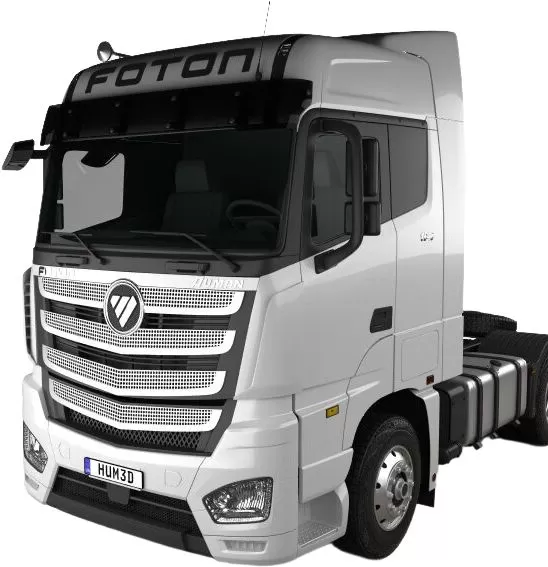
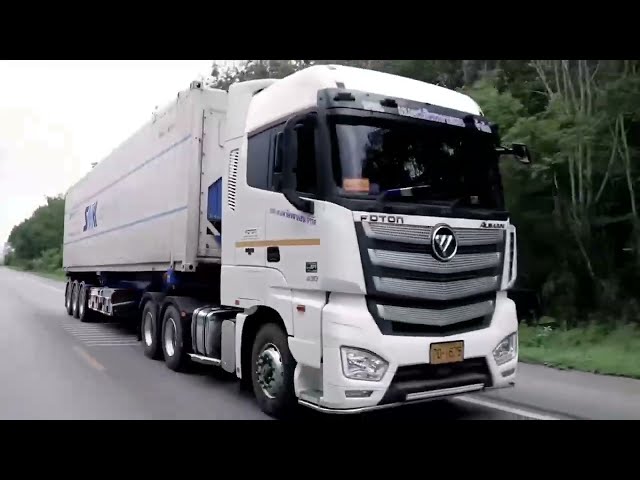
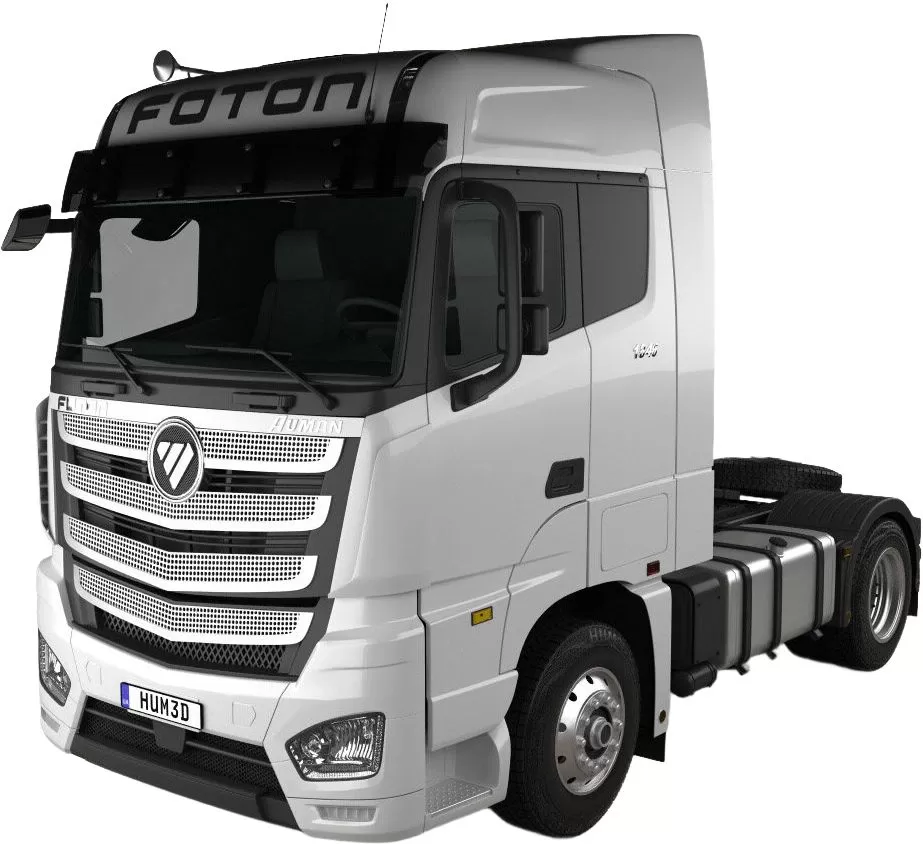
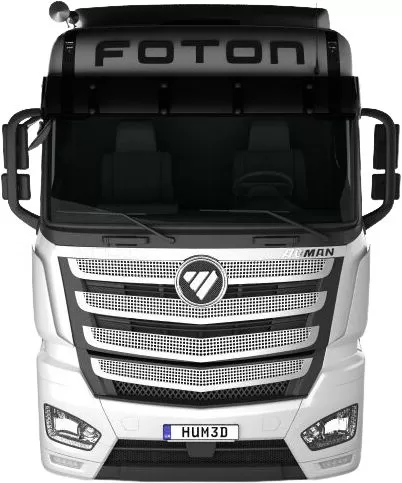
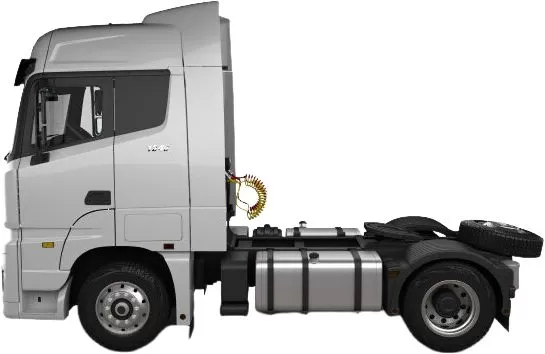
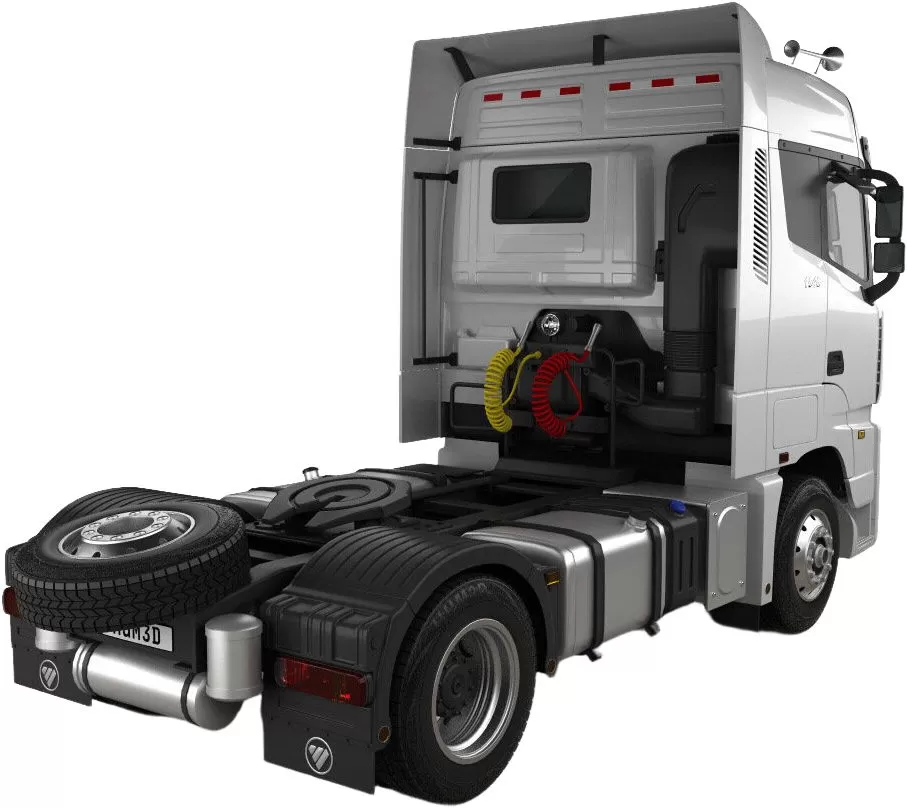
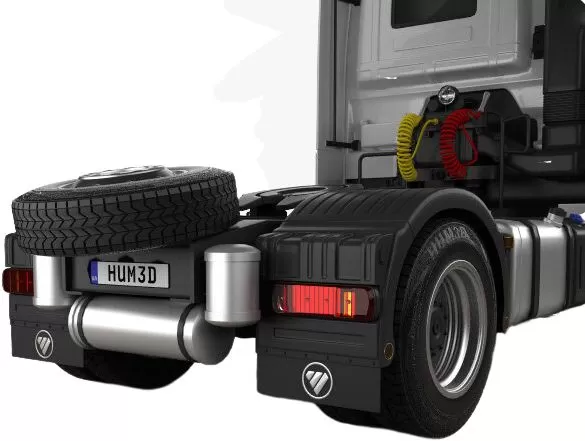
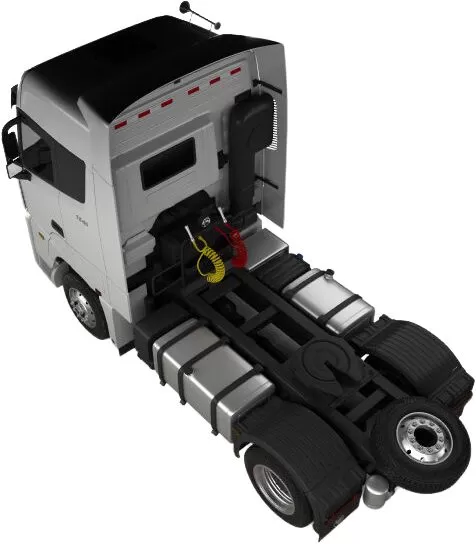
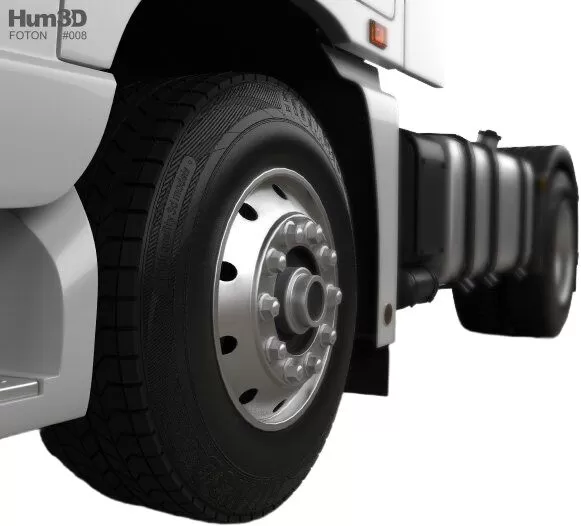


Long-haul economics are settled before the engine starts, in the choices made on the order sheet: what the combination may weigh, what the driver sits in for eleven hours, and how much of the descent the brakes never have to touch. The BJ4189SLFKA-F8 is a six-series EST-A machine built around those answers, a 4x2 prime mover for the long-haul high-efficiency role, rated at 45000 kg maximum design total mass with a kerb weight of 8330 kg, a 3800 mm wheelbase under a 6285 by 2490 by 3800 mm high-roof cab, and a 12900 ml engine rated at 413 kW or 560 ps driving a twelve-speed automated box through a 13 tonne rear axle, with a three-leaf front spring, an air-suspended rear, a thousand litres of combined aluminium fuel capacity, and disc brakes front and rear backed by a hydraulic retarder. The record carries no sales-country field, so it reads as a specification prepared for a market assignment rather than a single territory.
The engine is the X13NS5-560, 12900 ml, rated at 413 kW and 560 ps at 1800 r/min with 2600 N·m of maximum torque from 1000 to 1400 r/min, on a high-pressure common-rail injection system with a silicone-oil fan, homologated to China Stage V. The torque band is the story. A plateau that wide and that early means the truck makes its pulling work below the power peak, so a 45-tonne combination accelerates through the gear changes rather than around them, cruise rpm sits low enough to keep noise and wear down on the open road, and the engine is asked for full output rarely, which is the mechanical foundation of a high-mileage life. Common rail at China Stage V is a different ownership proposition from the mechanical Euro III units still sold into developing markets: it rewards clean fuel and disciplined filtration, and it depends on an emissions chain, urea above all, that the record does not describe. Confirm that chain before placing this truck where fuel quality is uncertain, because the drivetrain's best behaviour and the injection system's tolerance have to live in the same country.
The driveline is where this specification makes its modern statement. The gearbox is a 12TX2621TD in aluminium-housing form, shifted automatically rather than by cable and effort, and the model string carries the same retarder note that the auxiliary brake field confirms separately. The clutch is a 430 mm push unit with automatic electronic control, which in an automated twelve-speed means launches are programmed rather than ridden, and the driver's left foot exits the wear equation entirely. The rear axle is a 13 tonne 485 unit in drawn-housing form with imported wheel hub units, 3.083 gearing, self-adjusting arms and ABS, while the record lists three final-drive choices against three top speeds, 115 km/h at 3.083, 105.4 at 3.36 and 95.7 at 3.7. That ladder is the real tuning instrument for a long haul truck, and it deserves more thought than an option sheet usually gets, because it sets cruise rpm, fuel burn and the grade speed the fleet will actually live with.
Under the steel, the chassis pairs a conventional front with a modern rear. The front suspension is a longitudinal leaf pack, three leaves, with a stabiliser bar and shock absorbers, while the rear rides on air suspension without a lift function. The leaf front is the durable, cheap-to-fix choice on a steer axle that lift systems never really served, and the air rear is what protects the load and the trailer kingpin geometry on a 3800 mm tractor, holding the fifth-wheel height constant as fuel burns off and the coupling load works toward its 9540 kg rated value. The frame records an outer width of 900 mm front and 850 mm rear with 225/286 by 80 by 8 mm side rails, a tapered layout that gives the fifth-wheel mounting area the deeper, wider structure while narrowing toward the rear where a tractor's mass falls off. For an air suspension truck sold into rough-road markets, the honest caveat is the rear bag-and-linkage assembly itself, which tolerates abuse less gracefully than steel and wants a level yard and a disciplined coupling habit.
Braking is the specification's strongest chapter, and it interacts with one number that needs explaining. Service braking is dual-circuit air onto disc brakes at both ends, parking is spring-actuated air-release, and the auxiliary brake is listed as engine braking plus a hydraulic retarder, with ABS and self-adjusting arms on the drive axle. That combination is the heavy-weather answer: discs resist the fade and water-sensitivity that punish drums, and a hydraulic retarder absorbs sustained descent energy through fluid rather than through lining, which is why operators on graded routes count retarder kilometres as lining money saved. Against that stands the speed limitation field of 90 km/h, while the ratio table shows design maxima of 115, 105.4 and 95.7 km/h. The reading is straightforward, a governed ceiling of 90 for regulatory or fleet reasons with the mechanical speed reserved above it, but the two fields should be reconciled for the destination country's rules before the order closes, because a truck limited below its road capability is a different purchase than one certified to it.
The cab is the retention argument. It is an ESTA-2490 high-roof body in H5 trim, mounted on full-floating air suspension with electric tilt, which together decide how much of the road ever reaches the driver: air mounts smooth the low-frequency shake that accumulates into fatigue over weeks, and electric tilt is a workshop courtesy rather than a showroom one. The body combination lists electric windows, central locking, remote lock, the five-lock unification circuit, an air-sprung driver's seat with height adjustment, heating and armrest, and electric heated mirrors, with automatic air conditioning rather than the manual unit that appears on cheaper specifications. Entertainment is MP5 with radio, USB and radar, meaning the reversing radar is grouped with the head unit rather than listed as brake equipment, and the front structure is a split oversized fibreglass bumper, the replaceable-corner design that makes a yard ding a panel swap rather than a coach job. A tractor head bought for eleven-hour days is hired or abandoned on exactly this list.
Fuel and rolling stock complete the duty picture. The tankage is 850 plus 150 litres of aluminium, a thousand litres across the main and add-on units, which is line-haul capacity sized to the gaps between depots on a major corridor rather than to a regional circuit, and paired with the low-cruise intent of the quickest axle it converts into whole days between stops. No consumption figure appears anywhere in the record, so no range is claimed here beyond that arithmetic of intent. Tyres are 315/80R22.5 at eighteen-ply rating in a mixed pattern, the wide modern steer-and-drive size whose availability across major markets is itself a route-planning fact, and the 18PR marking is the heavy load range that matches the 45-tonne combination rather than a lighter regional one. Air filtration is horizontal and the muffler is a longitudinal rectangular unit, packaging details that matter to a bodybuilder or trailer matcher more than to a brochure.
Three businesses fit this machine and one does not. The core case is trunk-route line-haul, the 45-tonne road train moving palletised freight, consumer goods and retail replenishment between terminal cities, where the retarder pays for itself in lining intervals, the air rear protects high-value cargo, and the automatic box widens the recruiting pool to drivers who have never ground a cable-shifted twelve-speed. The second is dedicated contract carriage for a shipper who values schedule over price, where the thousand-litre range removes mid-route fuelling windows. The third is corridor work where hours rules force a governed 90 km/h anyway, and where a China Stage V engine is fine only if the urea and low-sulphur chains exist on both sides of whatever border is crossed. What does not fit is construction, tipper or logging duty, where an air rear, disc hardware and a 560 ps common-rail engine are the wrong three bets at once, and where a mechanical lower-emission machine with drums is the honest answer. As a 4x2 prime mover in freight work the fit is exact; outside it, the same list becomes a liability.
Ownership economics reward two things in this specification and charge for two others. The rewards: the hydraulic retarder plus engine brake converts descending energy into heat in a fluid circuit rather than into discs and pads, so on grade routes the consumable that dominates lesser trucks' ledgers shrinks dramatically, and the electronically actuated clutch removes the single most driver-dependent wear item on a manual truck, since standing starts, hill launches and the queue are all executed by program rather than by foot. The charges sit in the same places the technology does: common rail at China Stage V is intolerant of dirty fuel and lazy filtration, the emissions chain will want correct urea and periodic attention, and an air rear plus aluminium gearbox plus imported hub units is a repair catalogue that rewards a competent workshop and punishes a roadside improvisation. The 3.083 versus 3.7 choice should be made on the fleet's actual terrain and posted average, not on catalogue speed, because the long haul truck that earns is the one whose cruise rpm, limiter and gradient behaviour were picked for its route.
State plainly what this record does not contain. There is no sales country, no payload beyond the 8330 kg kerb weight and 9540 kg design saddle load, no fuel consumption, no range, no transmission brand, no clutch or axle maker named beyond the 485 housing code, no aftertreatment configuration behind the China Stage V label, and no warranty, service interval or after-sales term, none of which is claimed or implied here. The 90 km/h limitation field sits against ratio-linked maxima of 115, 105.4 and 95.7 km/h and must be reconciled for the destination market, and the 36540 kg approved towed mass against the 45000 kg maximum design total mass should be checked against the registration rules of the country of use rather than assumed from the tonnage label. Give us the corridor, the posted average speed, the terrain profile and the fuel and urea supply you can actually guarantee, and this tractor head can be confirmed against those numbers, the axle ratio chosen from the three published options and the air suspension truck configuration validated for the trailers it will couple to, before order rather than after arrival.


