
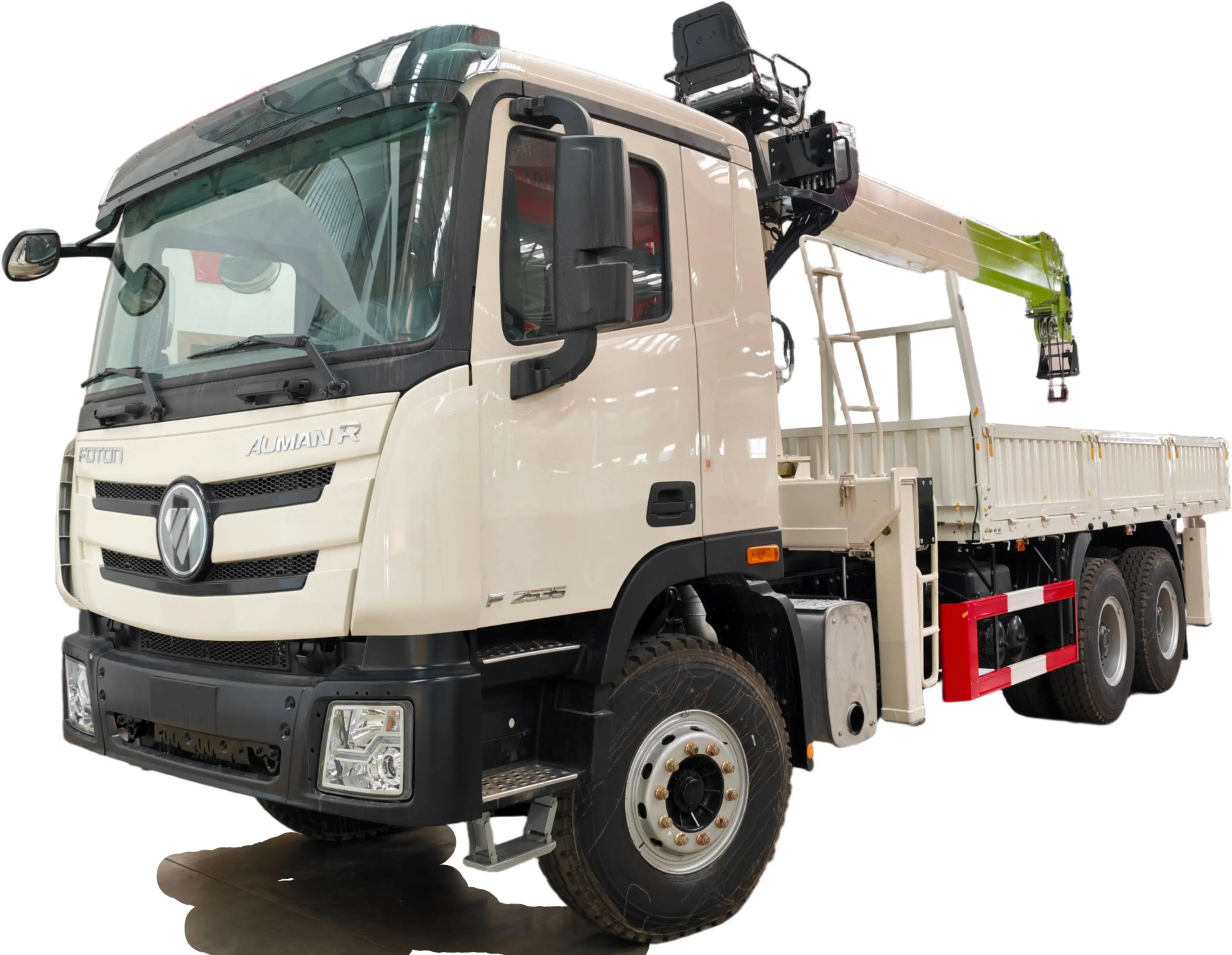


Most freight trucks arrive at a site and wait: for a mobile crane to be mobilised, for a dock with a forklift, for a crew with spare labour. Every wait is paid for by the operator, not by whoever caused it. The BJ1259VMPKE GTL is specified to remove that dependency: a 6x4 chassis carrying a 5700 mm flatbed with an SQS200BRU truck-mounted crane driven off a power take-off, rated at 40,000 kg gross vehicle weight, homologated for Turkmenistan. It is a genuine self loading cargo truck, one vehicle covering transport and lifting.
Start with the superstructure. The crane is an SQS200BRU articulated-knuckle unit behind the cab with telescopic rear outriggers, driven through a power take-off that takes engine output into a hydraulic pump rather than running a separate motor. A remote throttle is fitted, the detail that decides how the machine is actually used: the operator can bring the engine to working revs from the crane seat instead of leaving the controls, running to the cab, starting and returning ten times a shift. The flatbed measures 5700 by 2300 by 600 mm, a length that matters commercially because it matches most standard construction and industrial packages, timber, pipe, precast panels, machine bases, and the truck can receive them under its own hook rather than relying on the site's equipment. Knuckle boom, power take-off and long deck together define a working knuckle boom crane truck: no crane call-out fee, no waiting on a mobile unit, and no job too small to justify hiring external lifting gear.
The chassis is built to a heavier brief than daily loads suggest. Gross weight is rated 40,000 kg with a 10,700 kg chassis curb mass, and the design saddle load is stated at 27,350 kg, a figure that reads as a fifth-wheel rating rather than a body-mounting point and must be reconciled against the registration certificate before being used for load planning. The frame is 225/320 mm deep by 90 mm wide with an 8 plus 7 mm double web, outer width 865 mm front and rear, on a 4300 plus 1350 mm wheelbase producing 9600 mm overall length with 2005 mm front and 1880 mm rear track. Front axle rating is 7.5 tonnes; the rear is a Mercedes-type cast axle rated 16 tonnes with a 5.26 ratio and self-adjusting arms on ABS. A crane, its outrigger reactions and a full deck of dense freight behind one rear group are a torque problem before a weight problem, and a section this deep is how that twisting load is resisted without passing it into the body mounting.
Powertrain sizing is conservative for the duty cycle rather than the highway. The ISGe2-430 is an 11,800 ml six-cylinder diesel with high-pressure common rail, producing 315 kW, quoted as 430 horsepower, at 1900 rpm, with 2200 N·m held from 1000 to 1350 rpm. That wide low plateau is the figure to care about, because a crane truck spends much of its working life stationary with the engine running, driving a hydraulic pump rather than turning wheels, and low-rpm torque keeps a boom moving steadily while the drivetrain does nothing. The gearbox is an HW23712 in an iron casing, driven through a 430 mm pull-type clutch with hydraulic actuation air-assisted. Iron rather than aluminium is a deliberate choice for a machine worked hard at low speed, loaded and unloaded repeatedly: it tolerates abuse that would fatigue a lighter housing, and the service economy from Ashgabat to the regions is built around exactly this conventional transmission. Maximum speed is governed at 93.5 km/h and gradeability is 30%, suiting an asset moving between construction fronts and industrial yards rather than line-haul work.
The emission level is a configuration decision with consequences worth pricing honestly. This model is homologated to China Stage II, a deliberately low level of exhaust treatment rather than the higher standards the engine family can reach. Where no strict ceiling is enforced on imported heavy vehicles, Stage II buys what Stage V cannot: no diesel particulate filter to regenerate or replace, no selective catalytic reduction needing an additive supply chain, and no dependence on ultra-low-sulfur fuel to protect aftertreatment parts. The trade-off should be verified before ordering rather than after import: some registration authorities restrict what may be registered by emission level, and a lower-rated truck may not qualify, may face heavier inspection, or may resell for less. Nothing here resolves that question; it belongs with the authority in Turkmenistan.
What holds the vehicle up and what stops it follow the same logic. Front suspension is a longitudinal leaf assembly with stabilizer bar and shock absorbers; rear is an integral balanced leaf-spring bogie, leaf counts nine front and twelve rear. A balanced bogie answers the loading this truck actually sees, because a crane at the tail behind a loaded deck pushes mass rearward and the bogie spreads it across both driven axles instead of overloading one. Steering is a Bosch8098 unit; braking is dual-circuit air with drums front and rear, a spring-energy air-release parking brake, and engine braking as the only auxiliary system, no retarder fitted. That last point deserves attention rather than a passing mention: a 40-tonne truck descending a long grade without a retarder must be driven in gear and planned around, normal for this class but not something a buyer should discover after delivery. Tyres are 12.00R20 20PR on steer and drive, a heavy conventional size widely stocked across Central Asian markets, chosen for carcass strength on rough ground rather than the low rolling resistance of a wide-base highway tyre.
The cab is a GTL-2490 flat-roof body for two, on a semi-floating air suspension but raised manually for engine access, and the interior is built for durability rather than comfort. Electric windows, central locking with five-lock unification, a mechanical rather than air-sprung seat, electric mirrors, manual air conditioning, an MP3, radio and USB head unit without radar, a 165Ah battery, a modified 350-litre tank, an integral small metal bumper, horizontal air cleaner and vertical rectangular muffler. Two details are trade-offs rather than omissions. The mechanical seat means the driver absorbs more vibration over a shift than in an air-sprung unit, a real consideration on long corrugated access roads. The 350-litre tank is a modification rather than standard fitment and may need refuelling more often on long runs; confirm tank size against the routes actually run.
Where does a truck like this earn? The first case is construction logistics without site lifting gear. New-builds, roadworks, pipe-laying crews and remote housing rarely have a mobile crane standing by, and a flatbed crane truck delivers its own materials, places them where the crew needs them and leaves without waiting on someone else's equipment. The second is oil, gas and industrial-yard support across Turkmenistan's production regions, where equipment, spares and modular units must be moved and set down without a fixed dock or gantry, and where a heavy duty loader crane on a chassis this strong is essential plant rather than a convenience. The third is seasonal bulk handling: cotton modules, fertilizer, grain in bags, irrigation components, all moving in bursts with no permanent unloading at the collection point, handled faster and cheaper by one crew on a self loading cargo truck than by two crews and a hired crane. The fourth is machinery relocation between depots, quarries and workshops, and any heavy duty loader crane doing that work at walking pace is judged on stability and reach rather than on road speed.
Ownership economics follow the same columns, and on a flatbed crane truck they decide most of the lifetime cost. Working radius and lift charts are the missing figures a buyer should request in writing before pricing jobs, because deck length alone does not tell you what the boom can place at the far corner of that deck, and a 5700 mm bed needs reach as well as room. Telescopic rear outriggers help here: they let the machine set up in a confined lane or between parked plant where a crane with wide-swinging legs cannot open, and the rear position keeps the pads clear of the loading area. It earns its premium over a plain flatbed exactly where site lifting gear is scarce, which is most places outside a large city, and that is the argument for buying one machine that lifts rather than two that wait. Against that, a Stage II engine with common rail and no aftertreatment chain means no DPF cleaning, no urea storage or dosing faults and no catalyst replacement, a real saving where fuel quality varies by region. An iron-cased gearbox and a Bosch steering box are serviceable in any heavy workshop without proprietary software, and drum brakes with a self-adjusting rear axle are the least exotic friction parts in the trade. A power take-off removes a separate power pack, its fuel, its maintenance and its noise from the site.
State plainly what is not claimed. The crane record lists "bottom 3 cm, side cm, point cm," an incomplete line with missing values, so no plate thickness for boom base, side plates or pivot points is confirmed here. Rated lifting capacity, working radius, hydraulic flow, outrigger span and load charts for the SQS200BRU are not published in the supplied record, so no tonnage is quoted for the crane above. The 27,350 kg saddle figure and the 55-tonne combination figure are reproduced from the source but do not reconcile with the straight-truck configuration described, and must be checked against the registration document before any payload planning. No body tare, no payload figure for the crane-plus-deck build, no warranty or service term appears in this data, and none is implied; registration class and emission acceptance in Turkmenistan are set by the destination authority. Give us the heaviest single item you lift, the distance you move it and the deck length your loads need, and this knuckle boom crane truck is specified to those answers rather than to a brochure.


