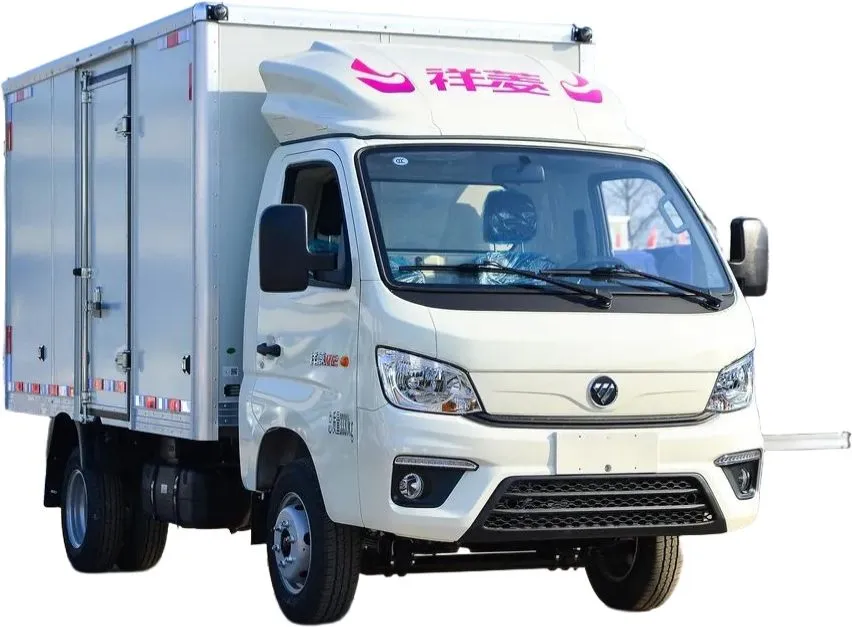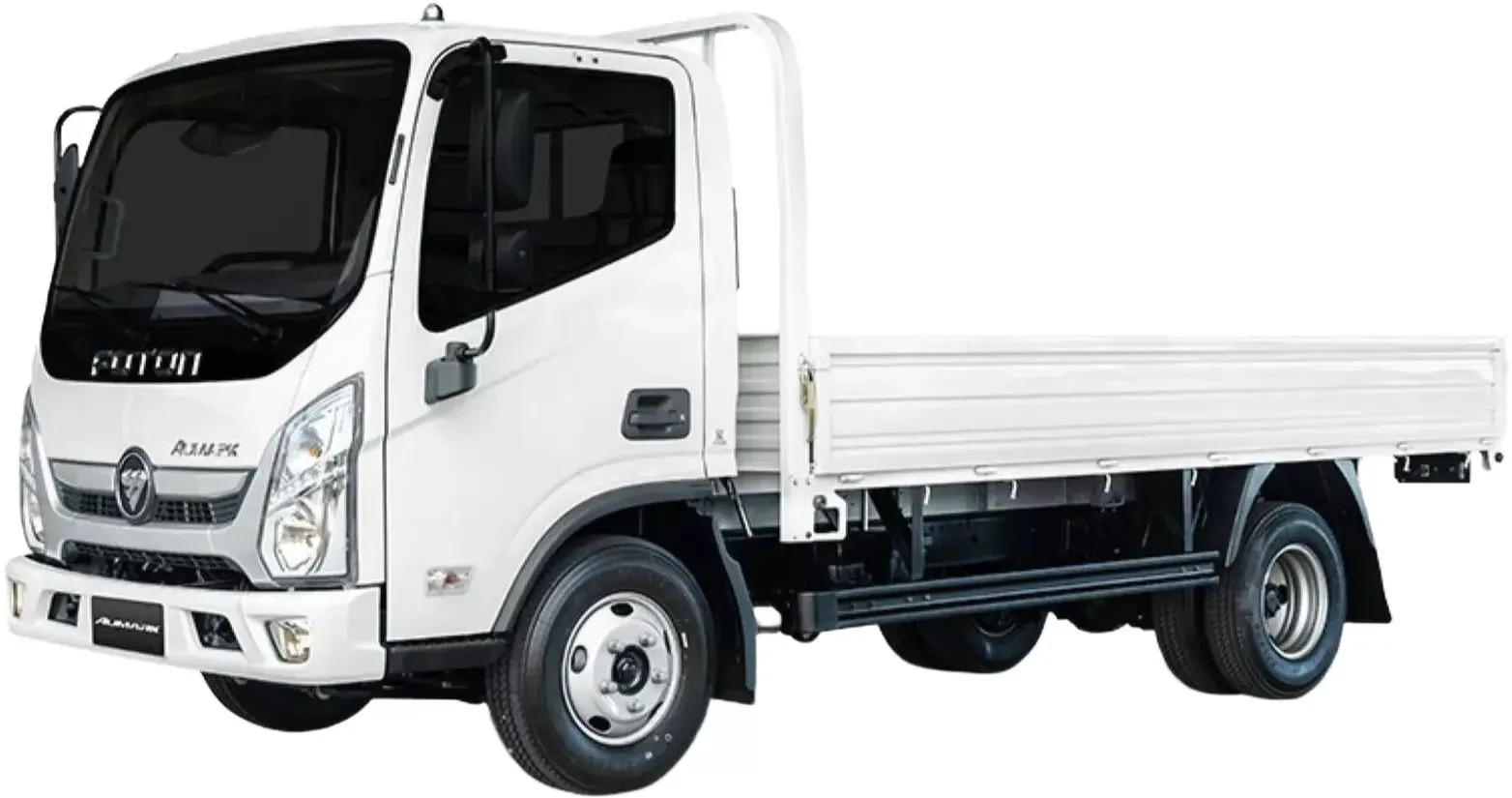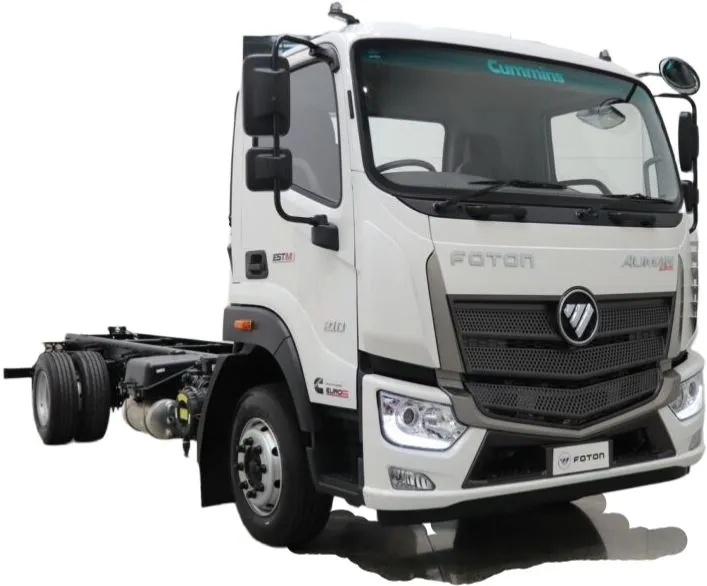
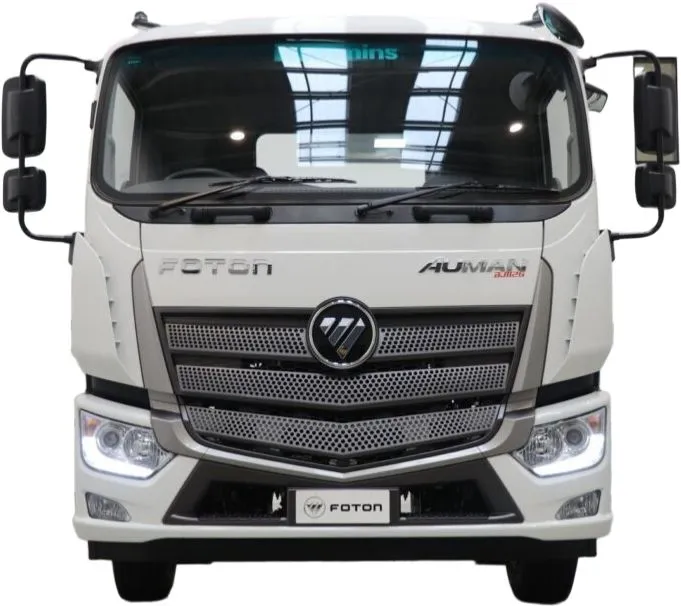
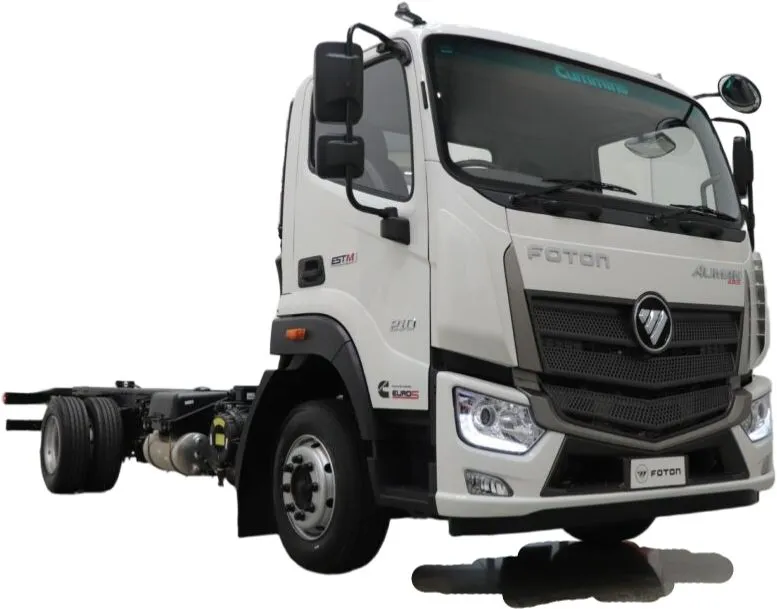
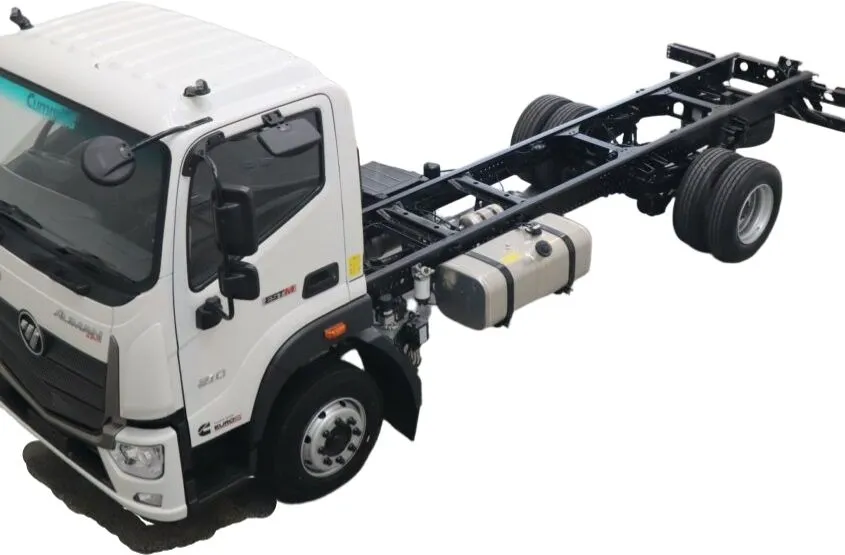


A rigid of this size is bought on different questions from a tractor and trailer. It has to turn inside a distribution yard, hold a gradient laden, and still hand the operator a legal payload after the body is built on. The BJ1226VMPHG-1 answers that brief directly: an Aumark EST-M heavy duty cargo truck prepared for Venezuela, 4x2, left-hand drive, 22000 kg gross vehicle weight, a 4800 mm wheelbase, and a chassis measured at 8560 by 2468 by 2780 mm under a row-and-a-half flat-roof cab for two. Power comes from a Dongfeng Cummins ISDe245 30, 6700 ml, 180 kW, 950 N·m, at Euro III, driving through a Shaanxi Fast 8JS105TA, over a 5.5 tonne front axle and a 10 tonne rear axle geared at 4.875, on tubed 10.00R20 radials, with air brakes, ABS, a wind deflector and a 200 litre tank. Nothing about that list is exotic, which is the point of a truck intended for a decade of serviceable life.
The engine is the strongest single item on the specification. A Cummins ISDe in 6.7 litres is an in-line six, and this state of tune pairs 180 kW with 950 N·m, a torque figure that matters far more than the horsepower number for a 22 tonne vehicle in real traffic. Torque per litre sits at roughly 142 N·m, a moderate specific loading, the sign of an engine working within its capacity rather than being squeezed for output, and moderate loading is what produces long overhauls on fuel of variable quality. Euro III rather than Euro V removes the aftertreatment dependency: no urea to source, no dosing module to fail, no catalyst substrate to be poisoned. The trade is documented rather than hidden, since a Euro III unit will not qualify where renewal inspection or registration rules tighten, so confirm acceptance before ordering. Beyond displacement, output, torque and emission level the record lists no fan type and no aftertreatment model, so build a maintenance plan around the commodity items every workshop stocks, filters, linings, belts and injectors, rather than around assumed equipment.
The transmission is a Shaanxi Fast 8JS105TA, the eight in the designation denoting forward ratios in Fast nomenclature, made by the manufacturer that equips most heavy chassis sold out of China. Eight ranges are not a luxury on a 22 tonne 4x2, they are a necessity, because one vehicle has to leave a loading dock with the maximum mass on it and then hold a reasonable engine speed on open road. A wide spread makes both possible, and the intermediate steps let the driver find a gear that maintains momentum on a climb instead of lugging the engine or resting on the brakes. Fast cases of this family are iron-housed, cheap to rebuild, and their parts circulate through every market in the region. The record does not list a power take-off for this build, so if the body needs one, specify it on the order sheet.
Axle capacity is where this build demands the closest reading, because the numbers do not line up as a buyer expects. The record lists a 5.5 tonne front axle and a 10 tonne rear axle, which is 15.5 tonnes of rated axle capacity against a gross vehicle weight of 22000 kg in the same table. Those two figures cannot both be the binding constraint, and the practical consequence is that the rear drive axle governs. On a 4x2 the rear axle carries the majority of laden mass once a long body is installed, since overhang behind a 4800 mm wheelbase adds leverage rather than relief, so a heavy steel body plus dense freight can overload the drive end well before a weighbridge reads 22 tonnes. Overloading a 10 tonne axle shows up as spring-seat cracking, hub and bearing heat, rapid drive-tyre wear, and a laden rear that loses grip first in the wet. Before any body is commissioned, get the completed-vehicle certificate mass and the permitted rear axle load for the approved variant, and treat this 4x2 freight truck as an axle-limited vehicle rather than a gross-weight-limited one.
Underneath, the chassis is a 250 mm frame section, the deep heavy-duty rail profile rather than the medium-duty sections used on lighter models, and suspension is leaf springs throughout at ten leaves front and a ten-plus-eight pack at the rear. That rear arrangement, a main ten-leaf stack with an eight-leaf helper, is progressive: the vehicle rides acceptably when empty, and the helper pack engages as load is applied so the spring rate rises with the mass carried. Ten leaves at the front is unusually generous and tells you the designers expected kerb strikes and unsealed loading areas. A deep frame plus a heavy spring pack is a stiff, repairable combination, re-bushable and re-clampable at any roadside shop, and it accepts a third-party body on standard U-bolts without welded brackets. This is why the box body truck conversion path is straightforward: the rail depth gives the bodybuilder clamping length, and the frame needs no reinforcement just because a panel-sided van is being fitted.
Braking is air actuated with drums at both axles and ABS as the control system, plus a spare wheel carried to make seven tyres in total. Air actuation is the correct answer at this weight for a rigid that will receive third-party bodies, because the compressor keeps supplying pressure as linings wear, and the same circuit runs a trailer if one is ever towed. Four-wheel ABS on a 4x2 rigid is more valuable than buyers assume, since an empty vehicle has a lightly loaded rear axle that locks easily on wet paint or spilled diesel, and the modulator keeps the back in line during a panic stop. Drum brakes remain the norm in this duty for cost and for resistance to grit, with the penalty being heat: repeated hard stops fade linings, and fade on a drum takes kilometres to recover rather than minutes. The record lists no auxiliary braking system for this build, a genuine gap on mountain roads, addressed in the descent guidance below rather than glossed over.
Remaining equipment rounds out a working specification rather than a showcase. Tyres are tubed radial 10.00R20, a size retained for availability and price, with tubes meaning a puncture can be repaired at the roadside without a specialist plug kit, and a penalty in heat retention on continuous high-speed running. A 2200 mm body width is stated for the load platform, a standard pallet-friendly dimension and the practical limit for legal width in most jurisdictions. Cab equipment is a manual air conditioner, an MP3 head unit, central locking with electric windows, and a driving recorder specified for overseas operation, the last item being a fleet-management requirement rather than a comfort feature. Fuel capacity is 200 litres, small for this class, and combined with the deflector, the 4.875 ratio and the 4800 mm wheelbase it defines the vehicle as a route truck with predictable refuelling rather than a long-haul machine.
Four businesses suit this chassis, and a fifth is excluded by one small number. The first is a regional distribution truck role: consumer goods, beverages, packaged food and spare parts moving on fixed circuits between a national warehouse and town-level outlets, where daily mileage is known, where refuelling happens at a depot, and where the row-and-a-half cab is enough because crews return each night. The second is building materials, cement, block, rod and tile, where the 250 mm frame and the ten-plus-eight rear pack are the whole argument, and where the rear axle warning above is most relevant because that freight is dense. The third is agriculture and produce on seasonal contracts, loaded at field edges on ground the frame has to survive. The fourth is general mixed freight for a contractor or a manufacturer moving finished goods, the use that pays for the deflector and the recorder and gets the highest annual utilisation. Excluded is intercity long-haul at continuous speed, because 200 litres of diesel on a 4.875 ratio does not buy the range that duty expects.
Ownership economics are settled by what wears and how cheaply it is replaced, and this specification is candid on that account. A 6.7 litre mechanical-era Cummins without aftertreatment has no dosing pump, no NOx sensor ladder, no urea heater loop and no catalyst to steal, so the failure categories that dominate modern diesel downtime are absent, and the parts that do wear, linings, springs, shackles, clutch plate, belts, filters and wheel seals, are commodity items. Against that, three items must be priced honestly: a 200 litre tank limits range and forces refuelling discipline, drum brakes without an auxiliary retarder will be replaced more often on gradient work, and a 10 tonne rear axle under a 22 tonne gross rating constrains body and payload more tightly than the headline number suggests. Bought as a heavy duty cargo truck for a ten-year horizon rather than a three-year resale, that trade is favourable, and the same logic decides the box body truck conversion: an aluminium or composite panel body recovers payload that a steel body would spend, and on this axle grouping payload recovery is the only free performance available.
State plainly what the record does not contain. No payload figure, body length, cargo volume, kerb weight, fuel consumption, range, gradeability or turning circle is published for this configuration, and none is claimed here; effective payload cannot be computed from these data and must come from the certificate for the exact approved variant. The 5.5 plus 10 tonne axle sum against a 22000 kg gross rating is a real inconsistency needing resolution with the manufacturer before a body is ordered, not a rounding difference. No warranty, service interval or after-sales network commitment appears in the record and none is implied, and the emission level being Euro III must be verified against current Venezuelan registration requirements. Send your route profile, your heaviest laden cycle and the body you intend to build, and this 4x2 freight truck can be confirmed against those numbers rather than a brochure, with the regional distribution truck duty that fits the 200 litre tank identified before order rather than after arrival.