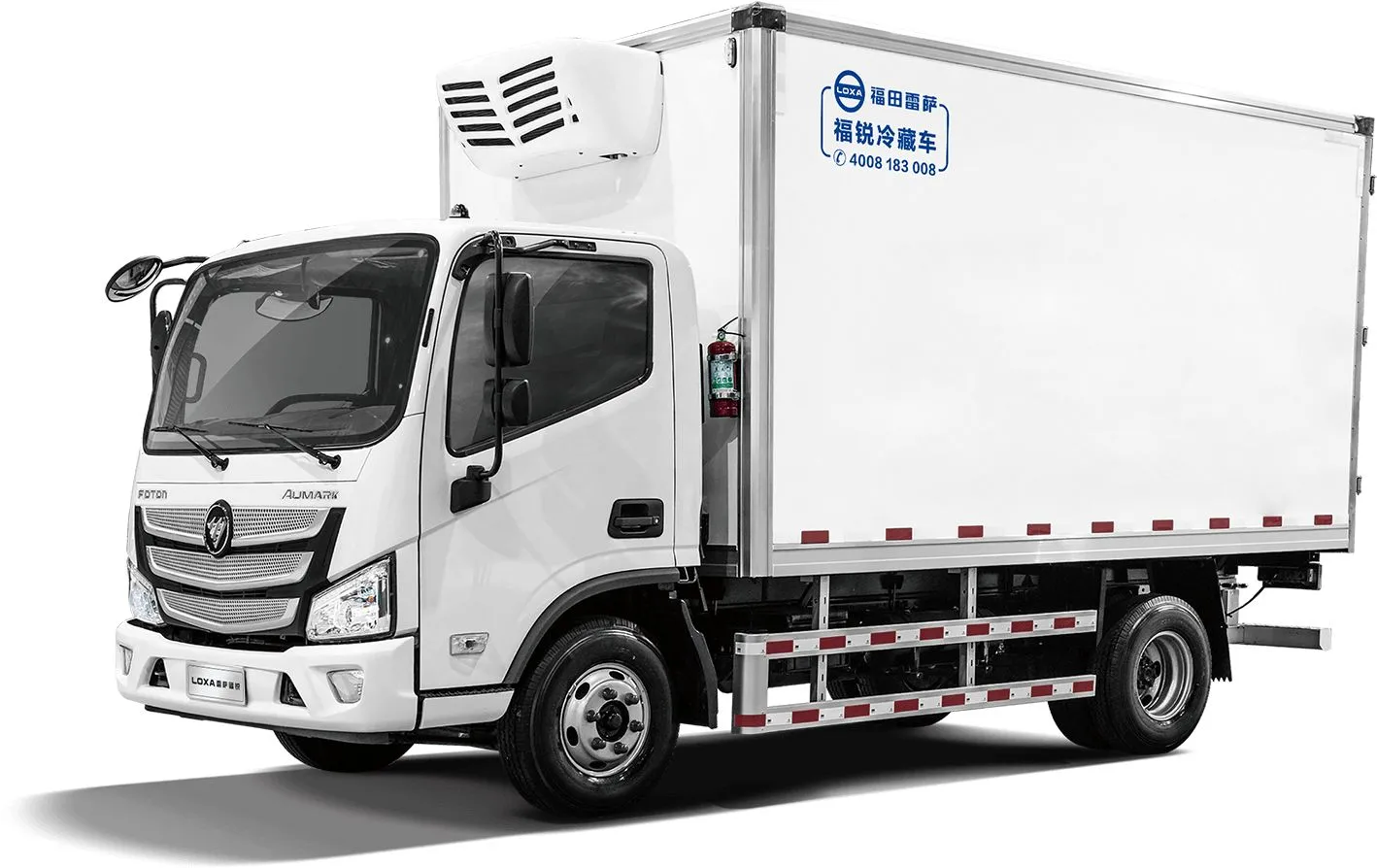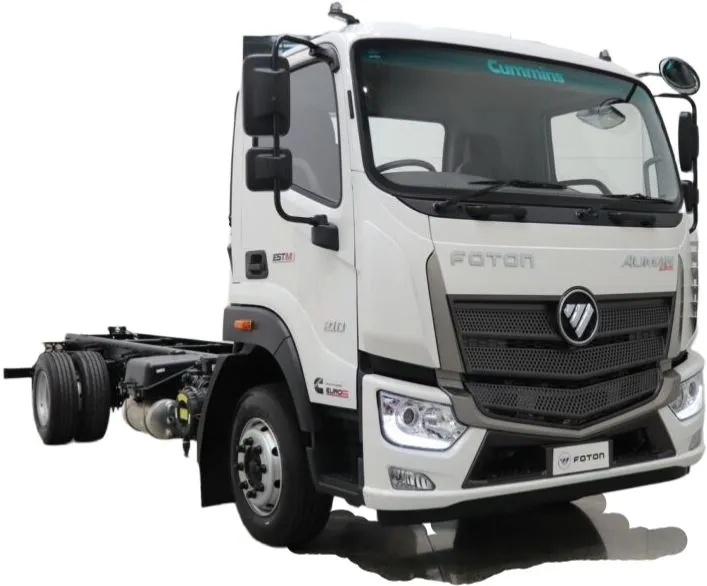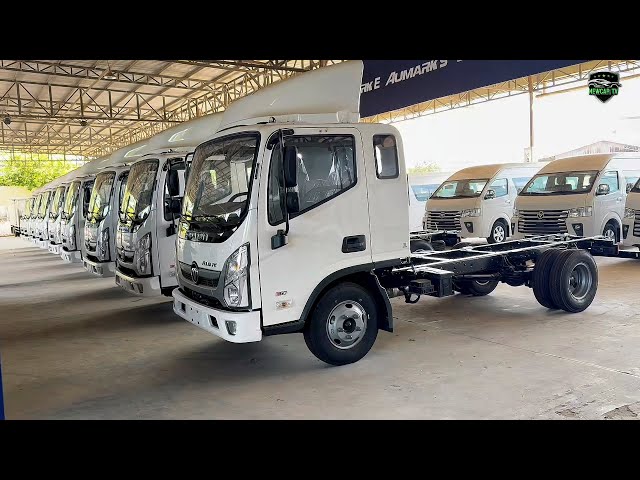


It is rare that one light-truck specification has to satisfy three continents at once, and rarer still when the honest answer is that the same box does it well. The M4 platform Aumark E is that specification, a 6-tonne light duty truck sold for Guatemala, Ecuador and Algeria, left-hand drive, 4x2, on a 3360 mm wheelbase inside a 5995 by 2060 by 2320 mm vehicle envelope with the bare chassis recorded at 5960 by 1940 by 2250 mm. Its nameplate work begins at the load platform, an internal 4170 by 1960 by 400 mm standard cargo deck, and its architecture is one of the most coherent small-truck lists in the range: an in-house Foton 2499 ml engine making 116 kilowatts or 158 horsepower, a ZF five-speed manual in an aluminium case, a 4.33 single-reduction drive axle, full air brakes with an exhaust brake as standard equipment, tubeless 7.00R16 tyres with a spare, 120 litres of aluminium fuel tankage, and a 6000 kg gross rating sitting under 6.9 tonnes of installed axle capacity. Guatemala, Ecuador and Algeria share little except punishment, and this truck answers with hardware rather than options.
The engine is the 4F25TC7, built by Beiqi Foton Motor itself, a 2499 ml four-cylinder turbodiesel recorded at 116 kW or 158 PS with 400 N·m of torque, calibrated to Euro III with the emission route field explicitly none and the base configuration stating no aftertreatment and no urea tank. That last clause is the truck's passport across three regulatory worlds, because a powertrain with no dosing hardware carries no fluid supply chain, no catalyst exposed to whatever sulphur content the regional pumps deliver, and no emissions fault logic to halt a loaded truck at the wrong altitude, which for the Andean corridors of Guatemala and Ecuador matters more than peak specifications suggest. The two caveats on the record are small but belong here: the torque figure is logged as 400 N·m with no rpm window given, and the power line, unusually, states both units cleanly, so the certified rev range should be read from the nameplate when marketing the diesel cargo truck rather than guessed from the plate.
The transmission is a ZF 5S408, a five-speed manual in the German maker's aluminium-housing light-truck family, coupled through a 310 mm diaphragm-spring clutch, and behind it sits a 4.5 tonne 295 single-reduction drive axle in stamped-welded construction geared at 4.33. For this class and these markets the pairing is the argument itself, because a ZF case at 6 tonnes gross means shift quality, a documented parts channel and a housing light enough not to tax the front axle, while the 4.33 stepping is chosen for a truck that will start laden on a gradient in Guatemalan highland towns and hold speed with the compressor-free engine load of a flat deck. The base configuration also lists a PTO switch as standard equipment, a small line with large consequences, because it means the chassis can drive ancillary equipment on future bodies, a tail-lift pump or a small crane, without rewiring, and the aluminium-cased box and 295 axle are known quantities in Algerian and Ecuadorian workshops alike.
Mass on this record is coherent in the way few listings manage, and that coherence is worth reading slowly. The GVW field reads 6000 kg while the axles are rated 2.4 tonnes front and 4.5 tonnes rear, an installed sum of 6.9 tonnes, roughly 900 kg of structural margin above the legal gross rather than the shortfall that haunts heavier headers. The practical reading is that this truck's lawfulness depends on nothing exotic: the payload is whatever the certified kerb weight leaves of the 6000 kg allowance, and the 6 ton truck arithmetic is completed once, at the weighbridge, when the finished vehicle is delivered. The certified GVW field itself is empty, which is the one number the certificate must supply, and the 1880 mm body width with a 4170 mm deck means the cargo plan is volumetric rather than weight-bound on most goods, bags, pallets and building stock filling the square metres before the tonnes.
The load body and the frame under it describe a working platform, not a showroom build. The deck is recorded internally at 4170 by 1960 by 400 mm, a standard cargo platform with low boards, giving roughly 8.2 square metres of floor on an 8 mm-spoke steel-rimmed chassis, and the record states no cargo-box accessories are included, which tells the bodybuilder where the truck ends and the customer's brief begins. The frame is 180 mm deep, 65 wide and 4.5 thick with 810 and 750 mm gauge points front and rear, suspension is leaf springs with three leaves ahead and a five-plus-two progressive pack at the back, and no stabiliser bars are fitted at either end. For a 4170 mm deck on a 6-tonne flatbed truck the low boards are a feature for loading hands and a limitation for loose goods, and the sensible fleet answer is the one every Latin American depot already knows, side boards or a tarpaulin frame added locally to the very deck this record delivers.
The brake line is the specification's quiet flex, and it reads almost like a heavy-truck list transplanted into a light chassis. Braking is full air front and rear onto drums under an ABS with a 4S4M control architecture, with a constant-pressure exhaust brake listed in the base configuration, self-adjusting brake-clearance arms, lining-wear alarms, spring-actuated parking on air loss, and aluminium air reservoirs. Each of those items solves a named problem in the three sales markets: the exhaust brake is free retardation on the long descents out of the Guatemalan and Ecuadorian highlands where friction linings alone would fade and fail; self-adjusters remove the manual adjustment discipline that growing fleets lose first; the wear alarm converts a grinding surprise into a dashboard notice; and air hardware in a drum package is what any workshop from Guatemala City to Oran can rebuild from local stock. For altitude work, the constant-pressure design keeps braking effort available with the exhaust valve doing the work and no added electrical complexity.
Rolling stock and tank are sized to the same philosophy of repairability. Tyres are tubeless LL7.00R16-12, six plus one spare, on steel rims with 8 mm spokes, the honest light-truck size for a 6-tonne gross, plug-repairable without a workshop and light enough that the driver's own jack tells the whole truth, and the 12-ply-category marking suits the mixed sealed-and-washboard reality the three countries share. The fuel tank is 120 litres of aluminium, listed in the base configuration with no larger option shown, which against a 2499 ml Euro III diesel and a 4.33 cruise describes a daily-radius machine, depot-fed on routes that return to fuel rather than cross the map between pumps. Cruise control is standard, a small mercy on the Panamericana and the trans-Algerian highway alike, and the single maintenance-free 120 amp-hour battery plus a 12 V socket keeps the electrical load of a working 6 ton truck as simple as the mechanical side.
The cab is an Ollin-derived single-row body 1880 mm wide carrying three on fabric seats, and its honesty is either its virtue or its first order-sheet conversation, depending on the buyer. The base configuration specifies manual windows with no central locking, a mechanical single-torsion-bar cab tilt, manual heating rather than air conditioning, and no reversing radar or daytime running lights, with fog lights, interior and side mirrors, a single overhead document cabinet, a multifunction steering wheel, hydraulic recirculating-ball steering with a height-and-rake adjustable column, and driver-side belt height adjustment included. Read as a working cab it is coherent, nothing fitted that a yard cannot fix; read for Algeria's summer it is incomplete, because a cab that lists heat but not cooling sends the air-conditioning question back to the quotation, and the same goes for the lock and window automation in dense city traffic. The 3360 mm wheelbase with 1590 and 1485 mm front and rear tracks keeps the whole light duty truck compact enough for old-town delivery streets in all three sales markets.
Three businesses fit this truck as recorded and one ambition does not. The first is highland general cargo, the Guatemala and Ecuador work of coffee, produce, manufactured goods and building supplies moved on the flatbed-deck pattern local transport already buys, with the exhaust brake and 4.33 ratio answering the terrain without options. The second is Algerian coastal and interior distribution, bags, panels and hardware on the same deck, where the no-urea powertrain and the ZF-and-Foton parts logic match the workshop landscape. The third is fleet starter-purchase work for operators building up from pickups, where 8.2 square metres and three cab seats cover the crew and the cargo together, the classic entry diesel cargo truck role in every one of these markets. What does not fit is buying it as a complete city-delivery package without the two conversations the record itself starts, the air-conditioning question for North African summer and the board or box decision for loose goods on a 400 mm platform, because both are order-sheet money rather than warranty money, and a flatbed truck of this clarity is best bought once, with those answers written in.
Ownership economics on this M4 are unusually favourable to the buyer, precisely because so little can go wrong on it. The powertrain has no dosing system to poison and no emission electronics to interrogate, the brake list has self-adjusters and a wear alarm protecting commodity drums, the gearbox is a ZF that every corridor workshop machines, and the only genuinely consumable mysteries are the tubeless tyre margins and the oil change clock that highland dust and idling quietly shorten. State plainly what the record does not contain, since the marketing must be as clean as the machine: no certified GVW figure, no kerb weight or payload, no torque rpm window, no service intervals, no warranty or after-sales terms and no air-conditioning commitment on this specification appear anywhere above and none is claimed here, with the 116 kW or 158 PS dual figure and the 4.33 gearing to be confirmed against the certificate of the exact approved variant and the Euro III level verified against each of the three countries' registration rules for the ownership horizon planned. Send the cargo type, the altitude profile and the deck accessory decision, and this Foton-engined, ZF-shifted, air-braked platform can be quoted complete rather than merely delivered.