Writer:Alan Chen(Foton Auman dealer)
"Distribution" in Algeria covers two very different jobs that are easy to confuse. One is moving people — hotel shuttles, staff buses, school runs, intercity commuter links — and the other is moving goods — market supply, parcels, spare parts, light construction material. The two vehicles configured for Algeria in this category are a deliberate pair that splits those jobs: the Foton TOANO electric passenger van for people, and the Foton Aumark E 6-tonne diesel cargo truck for freight. Read together, they cover most of an operator's urban and regional distribution need.
This article stays on one scenario — urban and regional distribution in Algeria — and only these two vehicles. Every figure is from the listings. Where a sheet leaves a gap, it is flagged. The most important thing to understand up front is that these are not two versions of the same truck; one is a zero-emission people-mover and the other is a conventional diesel cargo chassis, and you will rarely need both unless you run mixed people-and-goods operations.
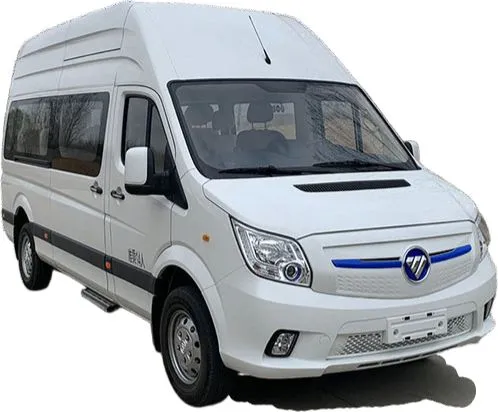
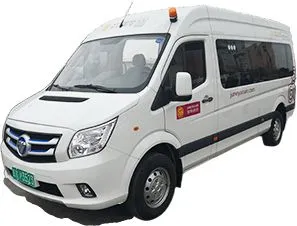
The Foton TOANO configured for Algeria is the BJ6608EVBA3 electric passenger van on a 4×2 layout, 3,750 mm wheelbase, 5,990 × 2,000 × 2,470 mm overall, with a 4.2 t GVW. It uses a CATL Lithium Iron Phosphate (LFP) single pack, bottom-mounted, driving an electric drive axle with a permanent magnet synchronous motor rated 60 kW / 130 PS peak and 110 / 360 N·m. Seating is offered at 14, 15, 17 or 18, and top speed is 120 km/h. Front and rear disc brakes, 215/75R16C tyres.
The same caveat from the chassis data applies here: the listing names CATL and LFP but gives no kWh, no range and no charge time. For an Algerian operator planning a Tirana-style urban loop or a regional link, that gap must be closed in writing before ordering. LFP is the right chemistry for a hard-working commercial vehicle, but you cannot plan a route around a battery you cannot measure.
The Foton Aumark E is a 4×2 diesel cargo truck on the M4 platform, 3,360 mm wheelbase, complete-vehicle dimensions 5,995 × 2,060 × 2,320 mm, with a declared GVW of 6,000 kg and a 6-tonne payload class. The engine is a Foton 4F25TC7, 2,499 cc, rated 116 kW (158 PS) with 400 N·m of torque, driving through a ZF5S408 five-speed manual. The drive axle ratio is 4.33. Fuel is a 120 L aluminium tank, tyres are tubeless LL7.00R16-12PR (six plus one), and the truck is left-hand drive with a single-row cab seating three.
The cargo box internal dimension is 4,170 × 1,960 × 400 mm — a flat, open three-panel body suited to general freight and market supply rather than tall stacked loads. The cab is a single row with a heating/cooling combined manual air conditioner, and the standard chassis carries ABS (4S4M), air brakes, front and rear drum brakes, and a 2.4 t front axle with a 4.5 t rear axle. The emission standard is Euro III, with no aftertreatment route listed. Note the country-of-sale field reads Guatemala / Ecuador / Algeria — confirm the unit offered to you is the Algeria-homologated one. The tubeless LL7.00R16-12PR tyres and the 400 N·m torque are adequate for the 6-tonne payload on the flat-to-rolling Algerian roads these trucks mostly see, and the 4.33 drive axle ratio gives a useful pull away from rest without sacrificing too much cruising economy on the regional legs.

| Specification | Foton TOANO EV | Foton Aumark E |
|---|---|---|
| Listed price | $33,527 | $17,820 |
| Role | Passenger van (people) | Cargo truck (goods) |
| Powertrain | Electric, CATL LFP, 130 PS peak | 4F25TC7 diesel, 158 PS, 400 N·m |
| Transmission | None (electric drive axle) | ZF5S408 5-speed manual |
| GVW | 4.2 t | 6,000 kg |
| Capacity | 14–18 seats | Box 4,170 × 1,960 × 400 mm |
| Wheelbase | 3,750 mm | 3,360 mm |
| Tyres | 215/75R16C | LL7.00R16-12PR, 6+1 |
| Fuel / energy | Battery (kWh not stated) | 120 L diesel |
| Emission | Not applicable | Euro III |
The decision between the TOANO and the Aumark E is not really a competition, because they answer different halves of the distribution problem. If your Algerian operation moves people — a hotel shuttle between a coastal resort and the airport, a staff bus between a plant and its dormitories, a school or intercity commuter link — the TOANO is the only one of the two that fits, and its electric drivetrain removes both fuel cost and tailpipe emissions from those short, repeated loops. Its weakness is the one we keep returning to: no kWh, range or charge time on the sheet, so the depot charging question has to be answered before the truck is useful.
If your operation moves goods — market supply, parcels, light construction material — the Aumark E is the tool, with a 6,000 kg GVW, a 4,170 mm box and a 120 L diesel tank that refuels anywhere. Its weakness is the Euro III line and the unclear homologation market. The price gap is large: the TOANO lists at $33,527 against the Aumark E at $17,820, and the EV also carries the uncosted burden of charging infrastructure. For a mixed operator running both people and goods, buying both is rational; for a single-task operator, buy the one that matches the load and do not pay for capability you will not use. Neither truck is a substitute for the other, and the specs make that obvious the moment you read "seats" against "cargo box".
Algeria applies axle-load limits on a Middle Eastern / Mediterranean pattern — a single-axle limit around 13 t, a tandem near 24 t and gross combination weight near 44 t — enforced by the Ministry of Transport. Algiers is the gateway, and the freight runs oil and gas plus the Sahara distances. The practical catch is that the Sahara distances and the heat punish an under-spec cooling system, so spec matters as much as the load number. The core business is oil, gas and long-haul freight, and a truck that is cheap to buy but expensive to run spends more of its life parked than earning.
For a distribution rigid the risk is the axle split — load the nose heavy and the steering axle is over before the gross weight approaches the rated figure, which is the most common cause of a fine on an urban trunk route.
In Algeria the reference vehicle is a used Japanese truck — Isuzu, Hino and Mitsubishi Fuso dominate the second-hand market — with European brands in the premium segment, Sinotruk Howo and Shacman as the main Chinese competition, and a large gray-market used fleet in some markets. The used Japanese truck wins on parts density but loses on age and the rebuild cost that lands within a couple of years. The new Chinese truck wins on warranty and a clean bill of health. Foton’s pitch is the middle ground.
Get the TOANO battery number. CATL LFP is named but no kWh, range or charge time is given. Close that gap in writing before planning any route.
Confirm the Aumark E homologation market. The country-of-sale field lists Guatemala / Ecuador / Algeria. Verify the unit offered is the Algeria-approved one.
Check the Euro III line on the Aumark E. It has no aftertreatment route listed. Confirm it against your Algerian permit before ordering.
Pick the role before the price. The TOANO moves people and the Aumark E moves goods; they are not substitutes. Buy the one that matches your actual load.
Both prices are published listing figures and are a starting point for enquiry, not landed costs — freight, duties, charging equipment for the EV, and local registration sit on top. Resolve the energy and homologation questions first; they decide whether either truck can actually operate after delivery.


Tel:+8615960378211
Email:[email protected]
Address: Unit 8,room 704,NO.492,XingLinWan Road,Jimei District,XiaMen Fujian China
Address: Unit 8,room 704,NO.492,XingLinWan Road,Jimei District,XiaMen Fujian China
Email:[email protected]
© Authorized Dealer of FOTON AUMAN 2026 All Rights Reserved, Auman truck is a commercial vehicle brand under the Foton Daimler
Privacy policy