Writer:Alan Chen(Foton Auman dealer)
A mine or quarry operator in Ghana does not buy a dump truck because of a horsepower badge. You buy it because you know how many tonnes must move from the face to the crusher or the stockpile in one shift, over a haul road the same trucks are destroying. In the dry season laterite is firm and fast; when the rains come the road becomes a rutted climb and cycle time doubles. Granite, ore and overburden are dense, so the box fills by weight before it fills by volume. Get the specification wrong and the fleet pays for it daily.
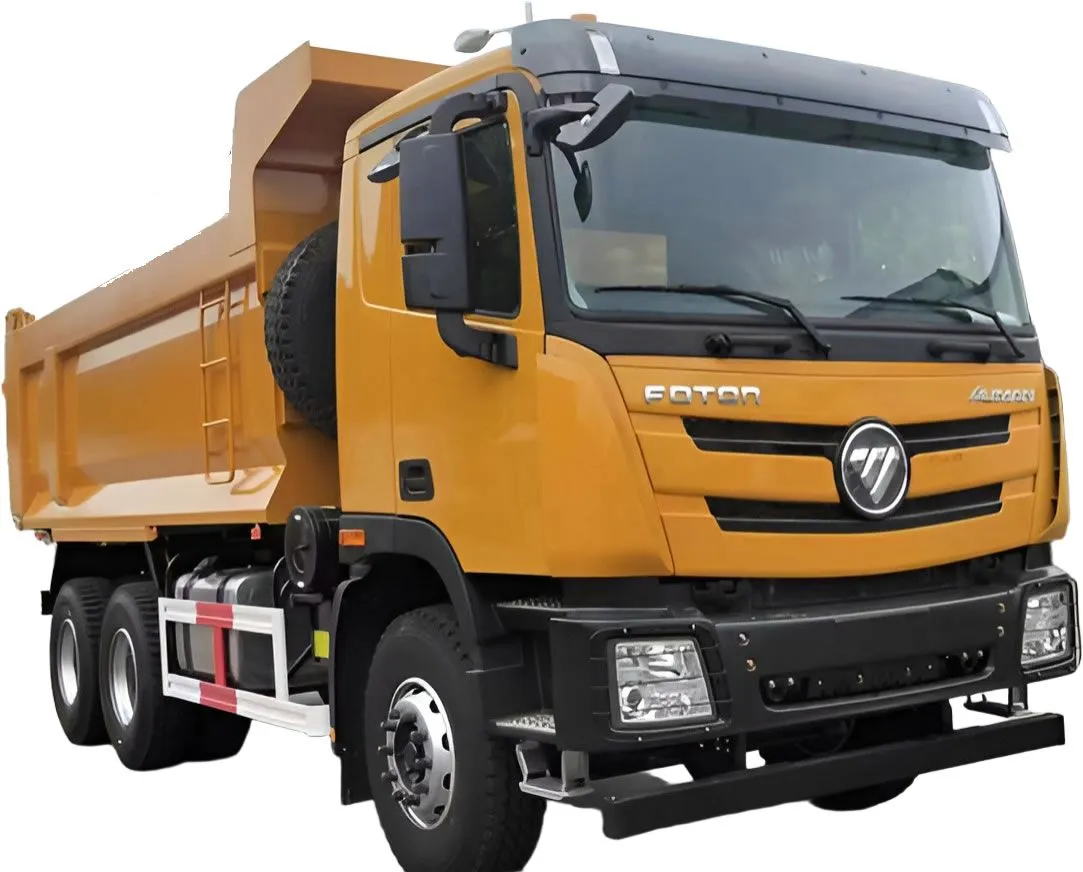
This piece covers one job only — mining and quarry haulage — and the three Foton Auman GTL-E tippers configured for it on the Ghana list. Two are 8×4, one is a 6×4. What separates them is not the badge on the grille but the box dimensions, the axle ratings, the final drive, the gearbox and the emission line. Every number below comes from the homologation sheets, and where a sheet disagrees with the headline, I say so.

All three run the 11.8-litre Cummins architecture — displacement is listed at 11,800 ml on every sheet — and all three place their torque peak at 1,000 rpm. That matters more than the horsepower figure: a loaded start on a ramp happens at low engine speed, and 2,100 or 2,200 Nm at 1,000 rpm is what gets the truck moving without burning a clutch.
The two 8×4 models are not identical under the bonnet, which is easy to miss because both are sold as 430 PS trucks. The listing at $58,520 (announcement model BJ3319DPPKC-3) carries the Foton Cummins ISG12 rated at 316 kW / 430 PS at 1,900 rpm with 2,200 Nm at 1,000 rpm. The $47,903 listing carries a Dongfeng Cummins ISGe3-430, also 316 kW / 430 PS at 1,900 rpm, but its sheet declares 2,100 Nm at 1,000 rpm. A 100 Nm gap sounds trivial on paper. On a wet laterite ramp with 25 tonnes behind the cab it is the difference between pulling away cleanly and stopping to restart in first. If your haul road has a sustained climb, that 100 Nm is worth part of the $10,617 price gap.
The 6×4 is the lower-output machine: Cummins ISG 400, 294 kW / 400 PS, 2,100 Nm at 1,000 rpm. Against a declared GVW of 25,000 kg rather than 31,000 kg that is a coherent pairing — less weight to launch, less engine needed. It is a shuttle truck for a shorter, better-maintained cycle, not the machine you point at the steepest ramp on the property.
Both 8×4s share one mechanical spine: wheelbase 1,800 + 4,300 + 1,400 mm, a 9-tonne front axle, a 16-tonne rear axle group, 13 wheels on 13R22.5 18PR rubber, a 350-litre aluminium tank, air brakes with ABS, leaf springs front and rear, a 5.26 final drive, GVW 31,000 kg. The 6×4 changes four of those numbers: wheelbase 3,825 + 1,350 mm, 11 wheels, a 4.76 final drive, GVW 25,000 kg. The 9-tonne front and 16-tonne rear ratings are common to all three.
The difference that decides it on a real site is length. The 8×4 chassis measures 10,600 / 10,800 × 2,495 × 3,580 mm on one sheet and 10,680 × 2,495 × 3,580 mm on the other; the 6×4 measures 7,500 × 2,490 × 3,400 mm. On a narrow bench or a switchback inside a pit, roughly three metres less truck and one fewer axle to drag through the turn is a real gain in cycle time. On a long, graded haul out to a plant, the extra 6,000 kg of declared gross weight is worth more.
One caution applies to all three. A four-axle rigid with a 9-tonne front axle and a 16-tonne rear group, and a three-axle truck with the same ratings, are read differently by different weighbridges and different axle-load rules. Check the declared axle loads against your local axle-load limits before you commit, not after the trucks have landed.

This is where the three trucks really separate. The 8×4 bodies measure 7,800 × 2,300 × 1,500 mm internally, which is 26.9 cubic metres struck. The $58,520 listing also offers an 8,000 mm length, which takes it to 27.6 m³. The 6×4 body measures 5,600 × 2,300 × 1,100 mm — 14.2 m³. Put simply, the 8×4 carries roughly 1.9 times the struck volume of the 6×4, and that ratio is the whole argument for buying the bigger truck.
Two dimensions matter more than the volume figure. The first is the 400 mm difference in side height — 1,500 mm against 1,100 mm. With blasted rock that bridges and shifts, the taller wall keeps the load inside the box on a cambered road. The second is the 2,300 mm internal width, identical on all three: measure your loading bucket against it before assuming three passes fills the box.
To turn cubic metres into tonnes you need one number the listing cannot give you: the bulk density of your own material. Multiply box volume by that density and compare the result with the declared gross weight. On dense ore the 6×4 hits 25,000 kg with the box barely half full; on light overburden the 8×4's 26.9 m³ fills first.

Both 8×4 listings declare a GVW of 31,000 kg. The same listings carry a tonnage badge of 80 T, and the $58,520 sheet also carries a GCW field reading 80,000 kg. Those are three different statements about weight, and only one is what a weighbridge reads on a rigid truck: GVW is the weight of the vehicle itself, while GCW applies to a combination with a trailer. Before you sign, confirm which figure your permit and insurer reference, and get the per-axle breakdown in writing. A truck bought on an 80 T badge and registered at 31,000 kg is an expensive misunderstanding.
All three run a Sinotruk / HOWO 12-speed manual gearbox in an iron case — HW23712 Iron (Q) on both 8×4s and HOWO HW23712 (Iron) on the 6×4. Iron cases are heavier than aluminium, but they take the shock loading of a dump cycle and a local workshop can rebuild them. There is no automatic option in this group, and no retarder or engine brake appears on any of the three sheets. On a long loaded descent that is the specification I would push back on: drum service brakes alone are not what you want holding a loaded 8×4 on a sustained grade.
Final drive is 5.26 on the two 8×4s and 4.76 on the 6×4. Read together with the tyre count and the declared weight, that pairing describes the intended duty clearly: the steeper 5.26 for launching 31,000 kg out of a pit, the taller 4.76 for a truck that spends a larger share of its cycle at road speed with a lighter load.
Frame section is 225/320 × 90 × (8+7) on all three — a reinforced, two-layer section, which is what you want when a loaded body twists the chassis over a badly maintained ramp. Brakes are air-operated drums front and rear with ABS: standard on both 8×4s, optional on the 6×4. On a truck that will spend its life on a loose surface with a shifting load, ABS is not a line item I would leave to chance.
Seating capacity is two on all three. The $58,520 8×4 lists automatic air conditioning as standard (option code Q), plus electric doors and windows, central locking, remote lock, five locks, airbag seats and manual rearview mirrors; its roof is a flat top and its body width is 2,490 mm. The $47,903 8×4 and the 6×4 both specify a short sleeper cab, left-hand drive, front and rear drum brakes and a 350-litre tank, with the 6×4 giving West Africa as its sales market and listing ABS as optional.
Tank capacity is the same 350 litres of aluminium on all three, with a tank option code L35 on the $58,520 sheet. For a pit-to-stockpile cycle of a few kilometres that is ample. If your haul runs to a distant plant or refuelling on site is unreliable, check 350 L against your daily burn — the L35 code suggests other tank configurations exist, so ask.
| Model (Ghana list) | Drive | Power / torque | Gearbox & final drive | Cargo box (internal) | Declared weight | Emission listing | Price |
|---|---|---|---|---|---|---|---|
| Auman GTL-E tipper (BJ3319DPPKC-3) | 8×4 | 430 PS / 2,200 Nm @ 1,000 rpm | HW23712 Iron (Q), 12-speed · 5.26 | 7,800 / 8,000 × 2,300 × 1,500 mm | GVW 31,000 kg · GCW 80,000 kg · 80 T badge | No emissions listed | $58,520 |
| Auman GTL-E tipper (ISGe3-430) | 8×4 | 430 PS / 2,100 Nm @ 1,000 rpm | HOWO HW23712 Iron (Q) · 5.26 | 7,800 × 2,300 × 1,500 mm | GVW 31,000 kg · 9 t front / 16 t rear | China III | $47,903 |
| Auman GTL-E muck truck (ISG 400) | 6×4 | 400 PS / 2,100 Nm @ 1,000 rpm | HOWO HW23712 (Iron), 12-speed · 4.76 | 5,600 × 2,300 × 1,100 mm | GVW 25,000 kg · 9 t front / 16 t rear | No emission requirements | $42,883 |
Ghana applies the ECOWAS harmonised axle-load standard through the Ghana Highway Authority and the Driver and Vehicle Licensing Authority (DVLA), with weighbridges on the main trunk roads. The statutory maxima mirror the regional framework: 10 t on a single steering axle, 18 t on a tandem and 24 t on a tridem, with gross combination weight capped around 50–55 t for a six-axle articulated rig. Enforcement in Ghana is more visible than in some neighbours — the weighbridges on the Accra–Tema and Accra–Kumasi corridors are active, and overloaded trucks are regularly pulled off to shed weight at the operator’s expense. The Accra–Tema motorway and the stretch north to Kumasi are the two arteries every commercial truck must use.
For a tipper the binding constraint is the haul from the pit to the trunk road, where the DVLA weighbridge is the point where an over-loaded unit collects its fine — and cocoa and port haulage runs through here, so the box that fills to the headline weight on site can be over the axle caps before it reaches the highway.
In Ghana the reference vehicle is a used Japanese truck, and every new Foton is priced against it. Isuzu, Hino and Mitsubishi Fuso dominate the second-hand market, with Sinotruk Howo and Shacman moving into the heavy end and Tata and Ashok Leyland holding the light rigid segment. The used Japanese truck wins on parts density and driver familiarity, but loses on age, odometer honesty and the rebuild cost that lands within a couple of years. The new Chinese truck wins on warranty and a clean service history but has to build a parts channel that is still thinner than the Japanese network. Foton’s pitch in Ghana is the middle ground, which is what a TCO-minded fleet buyer wants to hear.
Settle the weight basis first. GVW 31,000 kg on the 8×4s and 25,000 kg on the 6×4, against an 80 T badge and an 80,000 kg GCW field. Confirm which number your permit uses before the deposit moves.
Match the final drive to the ramp. 5.26 belongs on the truck that launches 31,000 kg out of a pit; 4.76 belongs on the shorter, lighter shuttle. Ordering the 4.76 truck for the steepest ramp on your property is the most expensive mistake available here.
Decide about ABS now. It is standard on both 8×4s and optional on the 6×4. A truck that spends its life on a loose surface with a shifting load should not be delivered without it.
Ask what holds the truck on a descent. No retarder or engine brake is listed on any of the three. If your haul road has a long loaded downhill, that question is worth more than 30 horsepower.
Pin down the emission line and the box length. One 8×4 sheet says China III, one says no emissions listed, the 6×4 says no emission requirements — and the $58,520 unit offers a 7,800 or 8,000 mm body. If your import permit requires a higher emission standard, confirm this line before ordering.
All three are listed as complete vehicles rather than kits, which is what makes per-unit import realistic, and both 8×4 sheets carry named announcement models. The prices quoted are the figures published on each listing and are a starting point for enquiry, not a landed cost — freight, duties and local bodywork sit on top. Start from the box volume your material needs, check it against the declared gross weight, and only then argue about the price.


Tel:+8615960378211
Email:[email protected]
Address: Unit 8,room 704,NO.492,XingLinWan Road,Jimei District,XiaMen Fujian China
Address: Unit 8,room 704,NO.492,XingLinWan Road,Jimei District,XiaMen Fujian China
Email:[email protected]
© Authorized Dealer of FOTON AUMAN 2026 All Rights Reserved, Auman truck is a commercial vehicle brand under the Foton Daimler
Privacy policy