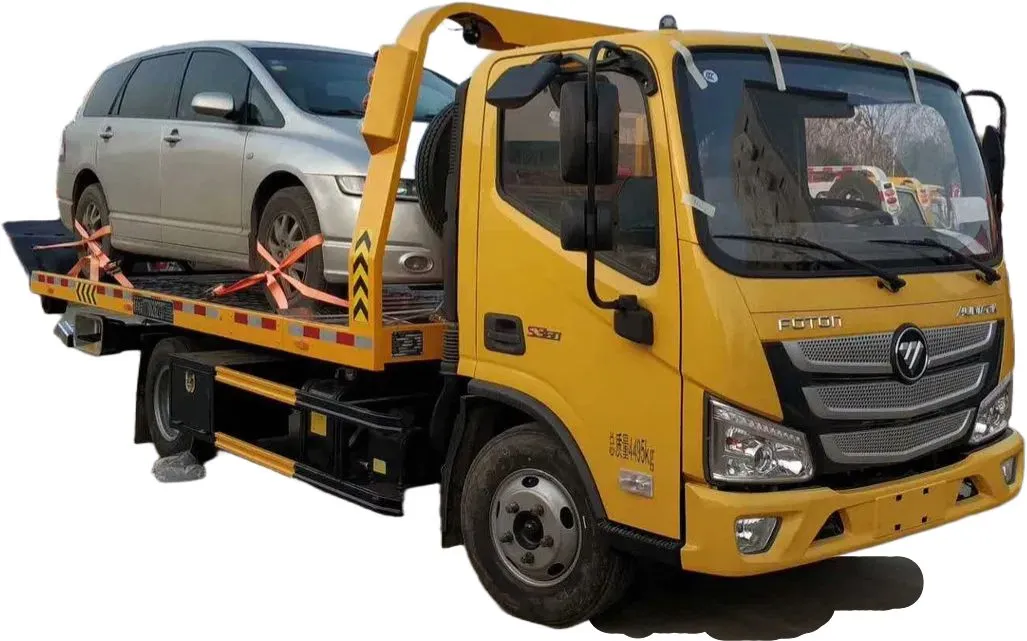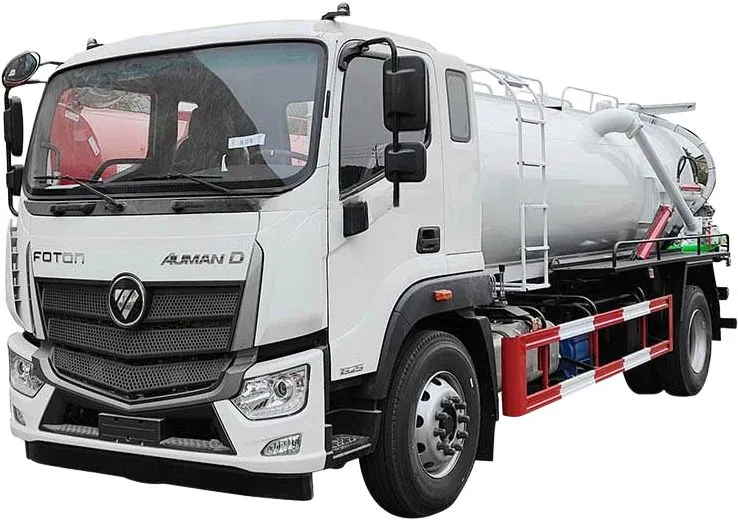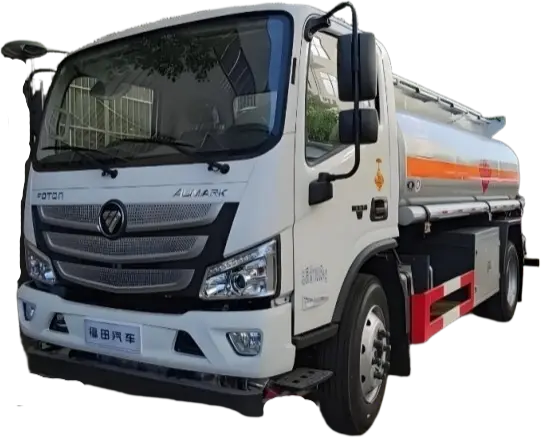
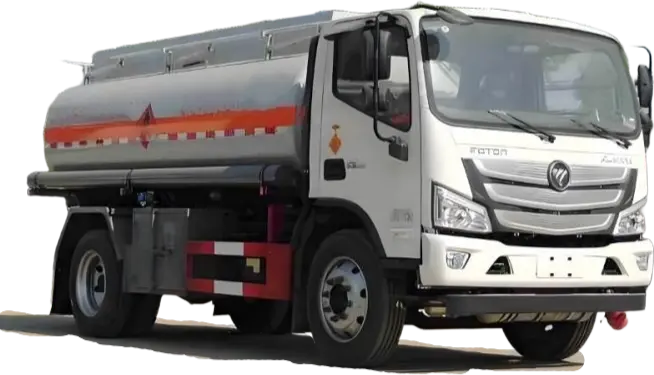
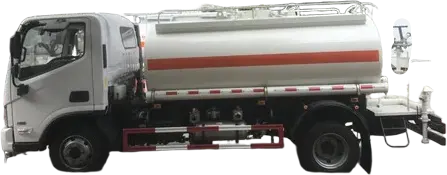
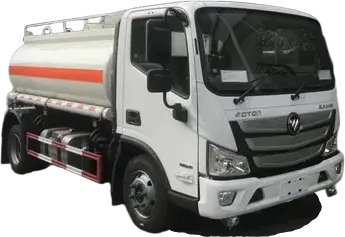
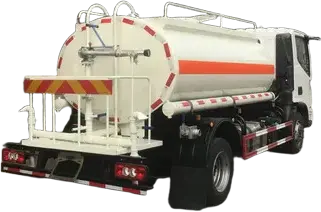


Fuel is the one consumable every contractor, farm, mine and station buys continuously, and the operator who moves it in his own truck stops paying a delivery premium on top of the pump price. The BJ1088VEJEA-F2 Aumark S is a 4x2 diesel chassis built around a 5 cubic metre tank, rated at 7495 kg gross vehicle weight, and it arrives as a complete unit: tank, power take-off driven pumping arrangement, dispensing equipment and the dangerous-goods hardware a fuel load requires. For a provincial distributor, a contractor with a plant yard, or an agribusiness that watches diesel move through its books daily, this converts logistics cost into margin.
The value starts under the cab. The ISF3.8s4R154 engine from Foton Cummins displaces 3760 ml, produces 115 horsepower at 2600 rpm and, more importantly for this duty, 500 Nm of torque across a 1200 to 1900 rpm band. That plateau is why a laden fuel tanker truck behaves differently from a general cargo truck on the same road. A loaded vehicle pulling away from a stop, climbing an access ramp or holding speed into a gradient stays inside its torque band without the driver chasing gears, and that is where fuel economy, clutch life and delivery punctuality are decided. Euro IV emission level keeps the engine on widely specified fuel and service practice rather than a niche supply chain.
Behind the engine sits a ZF6S500 transmission from ZF, matched to a drive axle ratio of 4.3. Six forward ratios on a 3.8 litre diesel with 500 Nm give the driver enough spread to hold a full tank at economic revs on an open highway and still crawl away from an uneven site entrance without slipping a clutch. This should not be exotic: an international gearbox and a mainstream engine family mean any competent workshop in a provincial city can diagnose the truck, order parts and put it back to work.
The chassis is where a tanker earns its service life, because a tank carries liquid that never stops moving. Braking pushes the surge forward, acceleration pushes it back, a corner rolls it sideways, and every impulse hits the frame. The 214 by 65 by 5 mm frame cross-section is the structural answer, a deep reinforced rail resisting the twisting load a shifting liquid applies between the axles. Axle capacity is asymmetric by design, 2.85 tonnes front and 6 tonnes rear, because most of a full tank sits behind the cab. Suspension is leaf spring front and rear with a 3 leaf front set and a 6 plus 7 rear set, and those rear leaves carry the real burden. Leaf springs are not glamorous, but on rough, unsealed roads they tolerate abuse, they are cheap to inspect, and any roadside fitter with a spring press can rebuild them, which matters when mining site fuel transport is the duty and no workshop is near. Tyres are 7.50R16-14 tubeless, six on the road plus one full-size spare, the correct count for a vehicle that cannot sit waiting for a replacement.
The body carries 5 cubic metres in Q235B carbon steel, plated at 4 mm on the shell and 5 mm on the heads, the two surfaces taking the most pressure and the most impact. Inside, the tank is divided by two transverse baffles at 3 mm, and those baffles separate a truck that drives predictably from one that does not. Compartmentalising the load breaks up the surge wave, so the vehicle settles sooner after braking and stays composed through a corner at half tank, the state it spends most of its life in. Anti-corrosion treatment protects the steel against what the product and the road throw at it, and over years of daily service internal corrosion is the most common reason a tanker is written off while its engine and gearbox still have life left. A power take-off is fitted, drawing driveline output into the pumping arrangement so the truck delivers product under its own power instead of depending on the receiving facility to pull it out.
That delivery capability changes the business case. With a dispensing gun, ten metres of hose on a reel, and a bottom valve controlling flow from the lowest point of the tank, the vehicle becomes a pump on wheels, able to serve a generator, a fuel bowser, a plant yard or a remote tank at the end of a track. A truck that reaches the machine instead of bringing the machine to the fuel removes two costs: the idle hour on the asset being served and the driver's round trip, which is why a planned gas station resupply schedule beats a larger tank standing at a depot. For a contractor whose excavators and dozers are spread along a long front, the productive hours saved can exceed the operating cost of the truck.
Safety equipment is specified as a package, and every item does a job. Two fire extinguishers cover the vehicle and the delivery point. A dragging grounding tape bonded to the frame dissipates static charge that builds as product flows and the body flexes on rough road, the ignition source that quietly causes tank fires during loading. A flame arrester in the vent path stops an external flame travelling into the vapour space. A hazardous-materials roof lamp makes the load identifiable to other road users and to inspectors. These are the fittings a fuel-carrying vehicle needs for dangerous-goods operation.
Braking a 7495 kg laden tanker is a hot, sustained duty, and the specification reflects it. Air brakes front and rear in a drum configuration give the stopping force a vehicle of this mass needs, and air actuation means the same reservoir that stops the truck works the emergency functions. Drums are chosen over discs not for heat resistance but because they are sealed against wash, mud and grit, suiting a vehicle that enters unsealed yards and gets pressure-washed at end of shift. ABS with EBD modulates that force, holding the steered axle under braking and distributing effort so a truck carrying a shifting liquid stays pointing where the driver left it.
Manoeuvrability decides whether a truck wins tight contracts. At 5960 mm overall length on a 3360 mm wheelbase, 2060 mm body width and 2280 mm height, it clears gates and widths larger tankers cannot enter and reverses into a confined yard without a banksman, which is the difference between winning and losing a construction site refuelling contract. Left-hand drive with a single-row cab for three matters commercially: the operator carries a driver and an attendant without a second crew vehicle, and both sit with manual air conditioning, an MP3 head unit, and central locking with power windows and remote control. On a hot, dusty run that cab is why a good driver stays. A 120 litre diesel tank gives the truck its own range, so a day of deliveries is not interrupted hunting for the product it carries.
Where does the money actually come from? The classic case is gas station resupply into townships and provincial outlets where a large road tanker cannot turn, cannot weight out on a small bridge, or cannot reach the forecourt at all. A 5 cubic metre truck fills that gap exactly: enough volume to make a drop worth driving, small enough to reach the site. For a station owner buying his own unit it becomes a direct-purchase channel, taking delivery at a depot instead of paying a reseller's margin on every litre.
For construction, the case is concrete. Plant on a linear project, roads, pipelines, transmission lines, is spread out, and refuelling excavators, rollers and generators by drum and funnel costs hours each shift and invites pilferage with every opened lid. A truck that rolls to the machine, bonds to ground, pumps measured product through a gun and logs the drop is a construction site refuelling solution that pays for itself in plant utilisation and inventory control.
Sugarcane, coconut, corn, rice and banana operations burn diesel in tractors, harvesters, trucks and irrigation pumps, in bursts concentrated in planting and harvest windows. Then the machines cannot be spared for a fuel trip, and farm and plantation fuel supply delivered to the field headland or pump house keeps peak-season machines working while letting the estate buy in bulk at the depot rather than in small quantities at retail.
For mining and quarrying the demand is identical with a longer approach: equipment sits at the end of a haul road, fuel sits at the gate, and only a truck stands between them. Mining site fuel transport on your own asset removes the add-on a third-party operator charges simply for driving there, and a reinforced frame, high-count rear leaves, sealing drum brakes, a self-contained pump and ten metres of hose are exactly what that shuttle asks for.
Against a heavier tanker this vehicle gives up volume and gains access, purchase price and flexibility. Against a cargo truck carrying drums it gives up nothing: the baffled, grounded, valved and extinguisher-equipped tank is the difference between carrying fuel properly and carrying it illegally. Ownership cost follows the mainstream specification, since a Foton Cummins engine and a ZF gearbox share parts with a huge installed base, leaf springs and drum brakes are the least exotic consumables in the trade, and 7.50R16 is stocked almost anywhere this truck is likely to fail. For the Philippine market the left-hand drive layout and the 5960 mm length suit provincial roads where a larger tanker would need permits. Buyers should still verify: product compatibility with the Q235B steel tank and its treatment, the local requirement for hazardous-materials markings and fittings, and the registration category for a 7495 kg vehicle in your province. Everything here is engineering fact from the approved specification for the BJ1088VEJEA-F2; nothing beyond it is implied. Confirm your product, your route, your drop volume and your site access, whether the job is farm and plantation fuel supply or a haul-road shuttle, and this fuel tanker truck is configured to that brief rather than to a brochure.