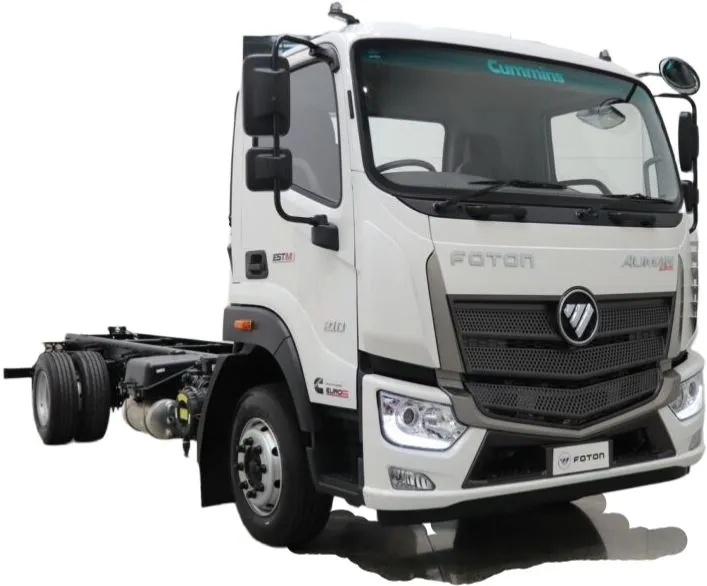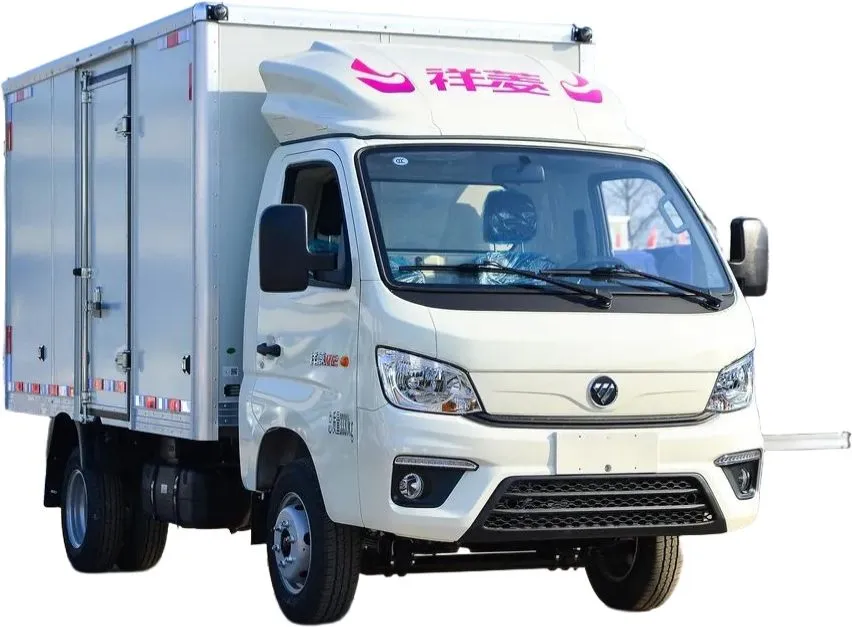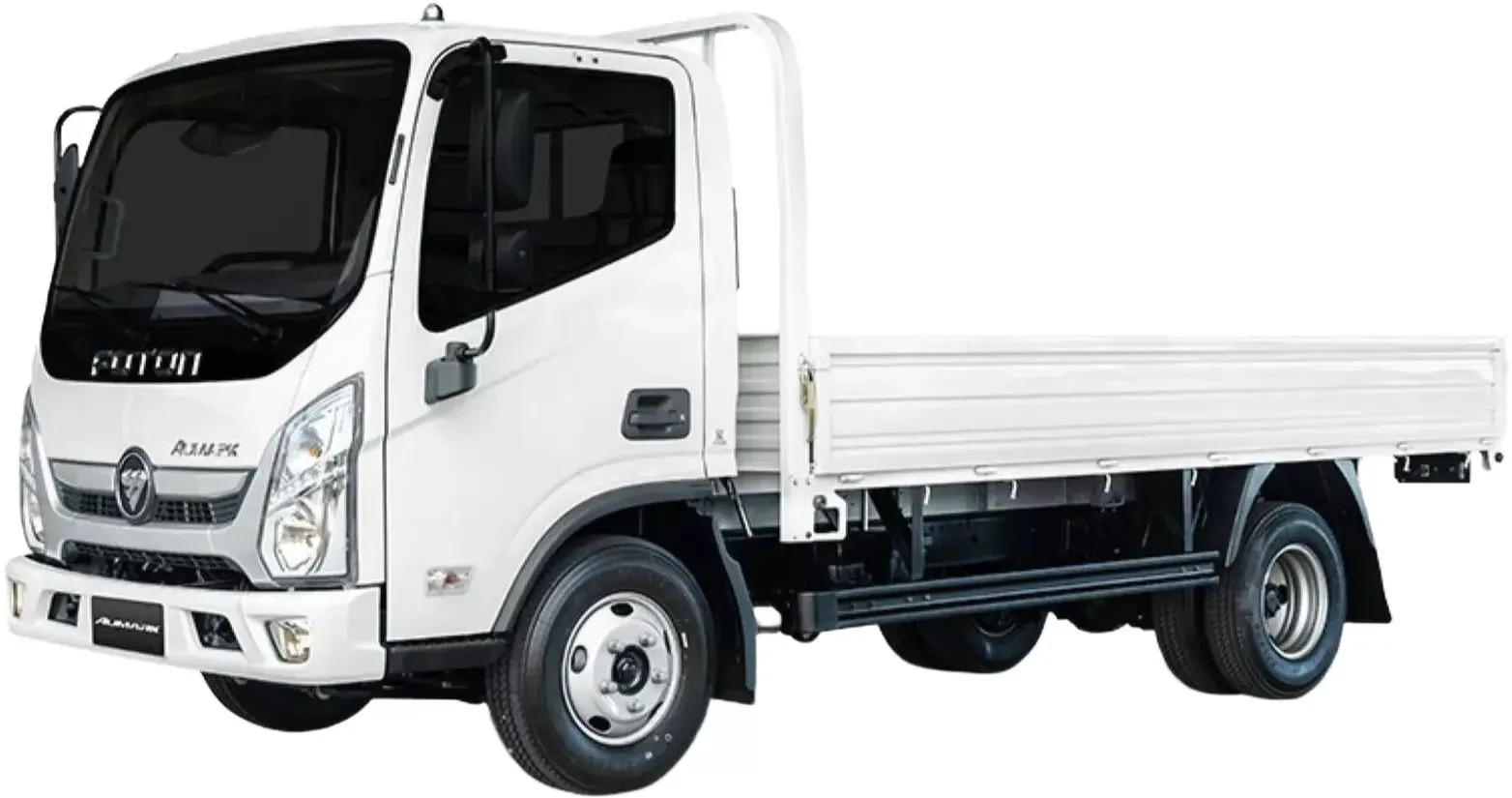
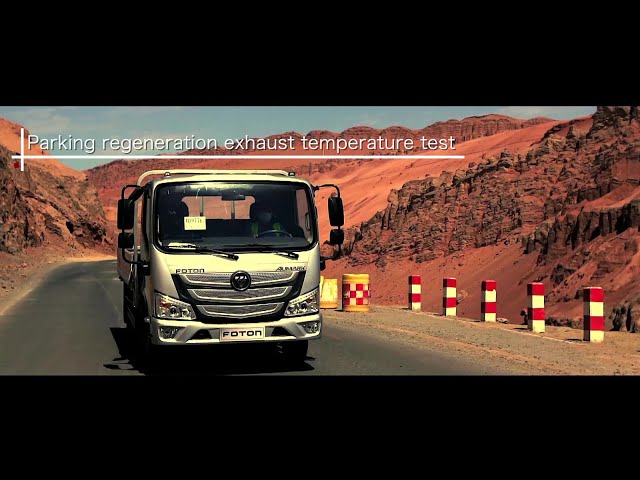


Two things decide whether a light truck survives in North Africa: what it does when fuel quality varies between one depot and the next, and what happens when something breaks four hundred kilometres from the nearest workshop. The BJ1088VEJEA-F Aumark S was developed against exactly those two questions. It is the Africa-market M4-platform light truck in the 7.5-tonne series, an N2-class diesel light duty truck at 8,500 kg gross vehicle weight, developed for Egypt and Tunisia with a mechanical-pump 3.76-litre Foton Cummins engine, a six-speed manual gearbox, drum air brakes and a payload just over five tonnes on a 4170 mm flat body. Nothing on this specification sheet is clever. Almost everything on it is correct.
The engine is the argument for the whole truck. The F3.8s3141 comes from Beijing Foton Cummins Engine, displaces 3.76 litres, and produces 105 kW with 450 N·m of torque. It is rated China Stage III at engine level with the vehicle approved to Euro III, and the aftertreatment section of the record is empty, which means there is no catalyst, no particulate filter and no dosed additive anywhere downstream of the block. That is a decision, not an oversight. The programme itself is titled a mechanical-pump project, and the virtue of a mechanical pump is what it does not need: no high-pressure common-rail injector to be coded with proprietary software, no sensor network whose fault strategy can limp the engine home, and no sensitivity to fuel whose sulfur and water content depend on which station filled the bowser. A dual-stage silicone-oil fan handles cooling, engaging only as the radiator demands rather than stealing engine power all day.
Behind the engine sits a 6S558 manual transmission on this build, a single dry diaphragm-spring clutch of 362 by 195 mm, and the detail that tells you how the truck is meant to be worked: the clutch is actuated hydraulically with pneumatic assist, so the pedal of an 8.5-tonne vehicle takes an effort a driver can repeat a hundred times a shift without fatigue. The rear axle is an integral banjo type with a 4.3 final drive and, crucially, a torque capacity of 10,784 N·m, the measure of how much twisting force the housing and its internals are built to survive rather than how much static weight they hold. Ratio choices exist because terrain does: the option list carries a large-ratio rear axle against the basic ratio, the honest way to convert this truck from a trunk-road specification into a hill-country or haul-road machine without re-engineering anything else.
The chassis is a riveted ladder frame, outer width 860 mm forward and 800 mm behind, with side rail sections of 129, 214 and 174 mm deep by 65 mm wide with 5 mm webs, front, middle and rear. Riveting is the repair-friendly construction: the frame can be straightened, re-drilled and re-riveted in a roadside shop, and a body bolts to it with U-bolts the way every body builder in Cairo and Sfax already works. The front is a non-decouplable I-beam axle rated at 2.85 tonnes with a 95 plus 8 mm drop; the rear NPR axle is rated at 6.0 tonnes with an 110 by 110 by 8 mm section. Suspension is leaf springs throughout, three leaves at the front and an eight-plus-six pack at the rear, with stabilizer bar combinations, none, front and rear, or multi-leaf front and rear, listed as options for operators running faster or taller bodies. Steering is recirculating ball with an 85 mm bore, the kickback-absorbing architecture, with power assistance standard. The loading deck stands 1090 mm high, a hand-cart height matched to the simple flat body.
Braking is where this build differs most sharply from its predecessor, and the change should be understood before it is judged. Against the previous version the ABS has been deleted and a load-sensing proportioning valve fitted as standard. Front and rear brakes are air-actuated drums with self-adjusting arms, parking is a spring brake released by air, and the auxiliary brake is an exhaust brake, the simple, robust retarder that costs nothing to buy and little to maintain. The proportioning valve reduces pressure to the rear drums as the axle lightens, which is the specific failure mode of an unloaded truck: without it the near-empty rear locks first and the vehicle swings on a wet or sandy surface. Deleting ABS removes the ring sensors, modulator and harness that fail first in this duty, and no workshop between Tunis and the interior needs a scanner to bleed these brakes. The trade-off is equally real and belongs in the operating plan rather than the brochure: anti-lock hardware measurably helps a driver keep steering during a panic stop on loose or wet surfaces, so drivers of this truck must be trained to the exhaust brake and the gearbox instead of to the pedal, and slower speeds on those surfaces.
The numbers that pay for the truck are the masses. In flat-body form the vehicle measures 5995 by 2200 by 2370 mm on a 3360 mm wheelbase, with an internal deck of 4170 by 2100 by 400 mm, a registered payload of 5115 kg, and three occupants on a 3190 kg curb mass against the 8500 kg gross. The bare chassis is 5950 by 2135 by 2320 mm at 2800 kg for the three-seat cab, the version a buyer sends to a local body builder. Maximum speed is 114 km/h. Tyres are 7.50R16 14PR tubeless in imperial size as standard, with tubed 7.50R16 and metric 215/75R17.5 tubeless listed as options: the tubed tyre because a puncture on a remote road is patched with a kit and levers rather than replaced, the 17.5 radial because it runs cooler and wears longer on sealed trunk kilometres. The 120-litre aluminium fuel tank is standard, with door and deflector options explicitly matched to a 160-litre tank for operators buying the longer-range specification, and the aluminium construction matters more than its weight in a market where a steel tank left idle through a rainy season is a tank written off.
The cab is a single-row three-seat body with a manual tilt for engine access, and the trim states its position honestly: fabric deluxe seats, power steering and an MP3 head unit standard. The options list is short and every item earns its place. A manual air conditioner is optional, and in this climate that is the first question to answer, not the last, because a cab without cooling loses drivers in July. An MP5 head unit with reversing camera, reversing radar and daytime running lamps are available, and the camera and radar are the equipment that prevents the reversing incidents which cost a fleet more in a year than the entire options list. There is no airbag, no driving assistance, no power take-off and no driving recorder in the standard specification.
Where does an 8.5-tonne truck of this shape make money? The first market is construction. A construction material truck carrying cement, block, rebar, sand and tile lives on payload margin, and 5115 kg across a 4170 mm deck puts this vehicle firmly in the class site haulage is priced in, while the exhaust brake and the low gearing hold it on job-site approaches with a full load. The second is agricultural trade: an agricultural goods transport truck moving olives, dates, grain in bags, fodder and produce from collection points to market through the season, on surfaces where the tubed tyre and the mechanical pump matter more than any comfort item. The third is general distribution between wholesaler and retailer, the working life of a flatbed cargo truck with side access and a deck at hand height. The fourth is the one the programme was written for: fleet purchase into markets where a truck must run on whatever fuel is available and be fixed wherever it happens to stop.
Ownership cost is decided at the specification stage, long before the first service invoice. The Cummins 3.8-litre family is known in every North African market that runs diesel trucks; parts for a mechanical pump are stocked in town rather than ordered from a capital. The consumables list is filters, belts, shoes and the occasional clutch, and the bill is labour rather than diagnosis, which where labour is cheap and electronics are slow is the correct economic shape. The diesel light duty truck segment also sits below the licence and road thresholds of heavier classes, which widens the driver pool, and the common tyre size keeps the tyre bill negotiable locally.
State plainly what is not claimed. This is not a tipper: no tipping body, hoist or power take-off appears in the record. The 5115 kg payload belongs to the standard flat body, so a locally built body must be weighed against the approved mass, because the allowance is spent before the first sack is loaded. The record carries no separate flatbed, box or stake approval under this model number, so the approved body form for export is confirmed on the certificate for the exact build rather than from this sheet. No fuel consumption, gradeability, turning circle, ground clearance or braking distance figure is published here, so none is quoted above, and emission acceptance, registration class and required equipment are set by the authority in the destination country. No warranty or after-sales term appears in the supplied data. Send us the load you carry most, the roads you run and the registration requirements in Egypt or Tunisia, and whether the target duty is a construction material truck build or an agricultural goods transport truck, and the ratio, tyre and tank options will be selected from the codes on this record, with the finished flatbed cargo truck confirmed against those answers rather than a brochure.