Writer:Alan Chen(Foton Auman dealer)

A Benin operator moving containers out of the Port of Cotonou is buying pulling power first and comfort second. The lanes from the port to the inland depots and on toward Niger and Nigeria are flat but heavily loaded, and the truck lives its whole life shuttling max-weight boxes. The material lists one unit for this West African port work: the Foton Auman GTL-E 6×4, a 90-tonne-gross tractor with a 400 PS Cummins and a 700-litre tank. This article covers that single scenario — port and container transport in Benin — and stays inside the published figures. Two points on the sheet need a straight reading, and I raise them rather than hide them: the emission tier and the country the listing was originally configured for.
The emission standard is Euro III. For a port tractor in a market where older tiers are still common, that may be acceptable — but Benin applies its own import and in-service rules, and you should confirm Euro III is still registrable for a heavy tractor before you commit. The second point: the listing itself names Nigeria as the selling country and is titled "for Nigeria." The truck is mechanically identical for regional West African duty, but the paperwork trail was built around Nigeria, so you must confirm the Benin type-approval and homologation path rather than assume the Nigerian file transfers.
The GTL-E runs a Foton Cummins ISG12, an 11,800 cc six-cylinder diesel rated at 294 kW / 400 PS at 1,900 rpm with 2,000 Nm of torque at 1,000 rpm. That is the torque you want for launching a fully laden container chassis from a standstill at the terminal gate. The gearbox is a Sinotruk HW-12MT (HW23712 iron-case), a 12-speed manual built for heavy, repetitive haulage. The drive axle ratio is 4.2, a working ratio that keeps the engine in its pull band under load rather than a cruise-geared number. With a GCW of 90,000 kg and a GVW of 25,000 kg, this is a true heavy-haul tractor, not a regional 4×2.
The axle setup is a 7.5-tonne front and a 16-tonne middle/rear axle group, on a 6×4 with a 3,300 + 1,350 mm wheelbase. Tyres are 13R22.5 18PR mixed/drive on 11 wheels. Overall chassis dimensions are 6,940 × 2,490 × 3,150 mm. The fuel tank is 700 litres of aluminium alloy — the single most practical number for port work, because a tractor doing multiple round trips a day from Cotonou should fill once and run, not queue at a pump between every shift.

The body assembly is listed as electric windows, central locking, airbag seats as standard and manual mirrors, with a flat-top cab. Air conditioning is listed as standard automatic — a meaningful feature in the Benin heat, where a driver spends 10–12 hours a day in the seat. Brakes are air brakes with ABS, the correct heavy-duty choice, and the steering gear is the AM90L-S. Seating is for two. None of this is luxury, and it should not be: a port tractor earns its keep by being serviceable, and the Sinotruk/ZF-class components here are the kind West African workshops already know.
One detail worth noting is the frame section: 225/286 × 80 × (8+5) mm, a heavy ladder frame built to take the twist of a maximally loaded fifth wheel. For container work, where the load sits high and the couplings see real shock, that frame stiffness is what keeps the chassis straight over years of terminal abuse.
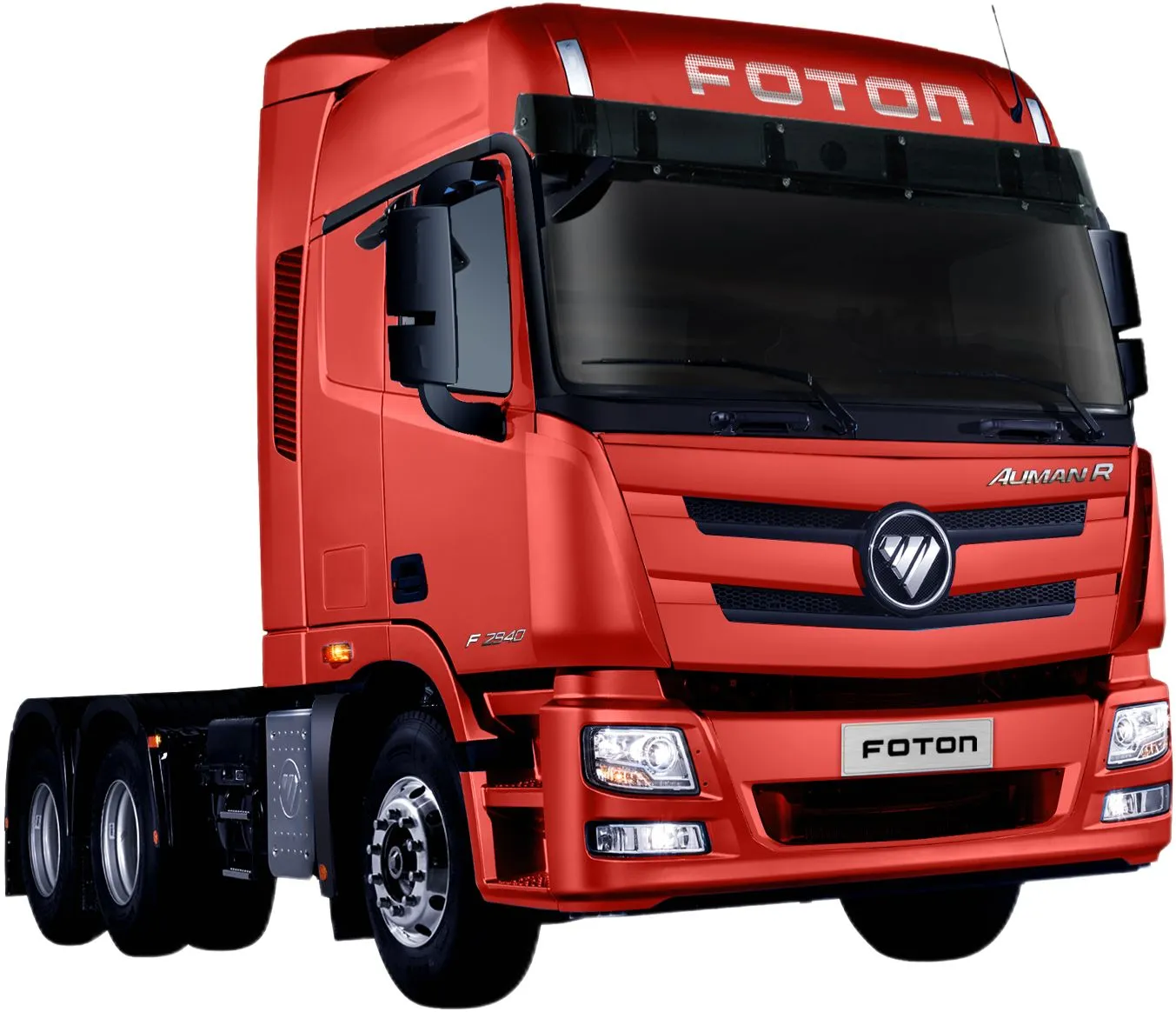

Tractor Truck · Benin (West Africa)
Auman GTL-E 6×4 — 400 PS, 90 t GCW, 700 L tank
Foton Cummins ISG12, 11,800 cc · 400 PS / 2,000 Nm @ 1,000 rpm · Sinotruk HW-12MT (HW23712 iron) · final drive 4.2 · 7.5 t front / 16 t rear · 700 L aluminium tank · GVW 25,000 kg / GCW 90,000 kg
Listed at $47,520 · Intermodal freight, bulk and heavy-load haulage
The 90,000 kg GCW is the headline, but the numbers that decide whether this tractor suits your specific port are the axle ratings and the wheelbase. With a 7.5-tonne front and a 16-tonne rear group on a 3,300 + 1,350 mm wheelbase, the GTL-E is set up for a stable, heavily laden fifth wheel rather than agility in a tight terminal. For a 20-foot box the shorter wheelbase section keeps the tractor unit manoeuvrable; for a 40-foot or a double-stack the 16-tonne rear is what carries the load without overloading the suspension. The 13R22.5 18PR tyres are a heavy-mix/drive pattern, the right call for a tractor that lives on a rough yard and a long highway run alike.
The 700-litre aluminium tank deserves a second mention in the port context: a tractor doing multiple terminal-to-depot round trips a day should fill once and run, and aluminium keeps tare down versus steel. The flat-top cab is a deliberate choice too — it keeps overall height at 3,150 mm, under the kind of bridge and depot-clearance limits that catch taller tractors. None of this is accidental; it is a chassis built for repeated, dense, port-grade work.
Benin applies the ECOWAS harmonised axle-load standard through the Ministry of Transport, with the statutory maxima of 10 t on a single steering axle, 18 t on a tandem and 24 t on a tridem, and gross combination weight capped around 50–55 t for a six-axle articulated rig. Cotonou is the primary gateway for landlocked Niger and the northern Sahel. The practical catch is that transit trucks are weighed again at the interior checkpoints on the way north. The core business is transit freight to Niger and the Sahel, and a truck that leaves the gate legal still has to survive the run to the interior before it earns anything.
For a container tractor the real exposure is the Cotonou access road: an overweight box scaled at the gate is offloaded on the spot, and there is no cheap way to recover it from the port road.
In Benin the reference vehicle is a used Japanese truck — Isuzu, Hino and Mitsubishi Fuso dominate the second-hand market — with Sinotruk Howo and Shacman as the main Chinese competition and Tata or Ashok Leyland on lighter rigid work. The used Japanese truck wins on parts density and driver familiarity but loses on age, odometer honesty and the rebuild cost that lands within a couple of years. The new Chinese truck wins on warranty and a clean bill of health but has to build a parts channel that is still thinner than the Japanese network. Foton’s pitch is the middle ground, which is exactly what a TCO-minded fleet buyer wants to hear.
Confirm Euro III is still registrable. The truck is listed Euro III. Verify with Benin Customs and the transport authority that a Euro III heavy tractor can be imported and plated today, and get it in writing before paying.
Resolve the country-of-origin paperwork. The listing is titled and configured "for Nigeria" with Nigeria as the selling country. Confirm the Benin type-approval, homologation and warranty path, since the Nigerian file may not transfer automatically.
Check axle loads against your containers. The 7.5 t front and 16 t rear are rated for 90 t GCW. Confirm your loaded kingpin and axle weights sit inside those figures for your typical 20- and 40-foot boxes.
Plan the tank and the depot. 700 L is generous, but confirm diesel quality and the nearest bulk supply to your terminal, because a port tractor's uptime is only as good as its fuel source.
For Cotonou container work, the Auman GTL-E 6×4 is a straightforward heavy tractor: 400 PS, 90 t GCW, a 700-litre tank and a durable iron 12-speed. Sort the Euro III and Nigeria-paperwork questions on paper first, and it is a workmanlike choice for West African port haulage.


Tel:+8615960378211
Email:[email protected]
Address: Unit 8,room 704,NO.492,XingLinWan Road,Jimei District,XiaMen Fujian China
Address: Unit 8,room 704,NO.492,XingLinWan Road,Jimei District,XiaMen Fujian China
Email:[email protected]
© Authorized Dealer of FOTON AUMAN 2026 All Rights Reserved, Auman truck is a commercial vehicle brand under the Foton Daimler
Privacy policy


