Writer:Alan Chen(Foton Auman dealer)
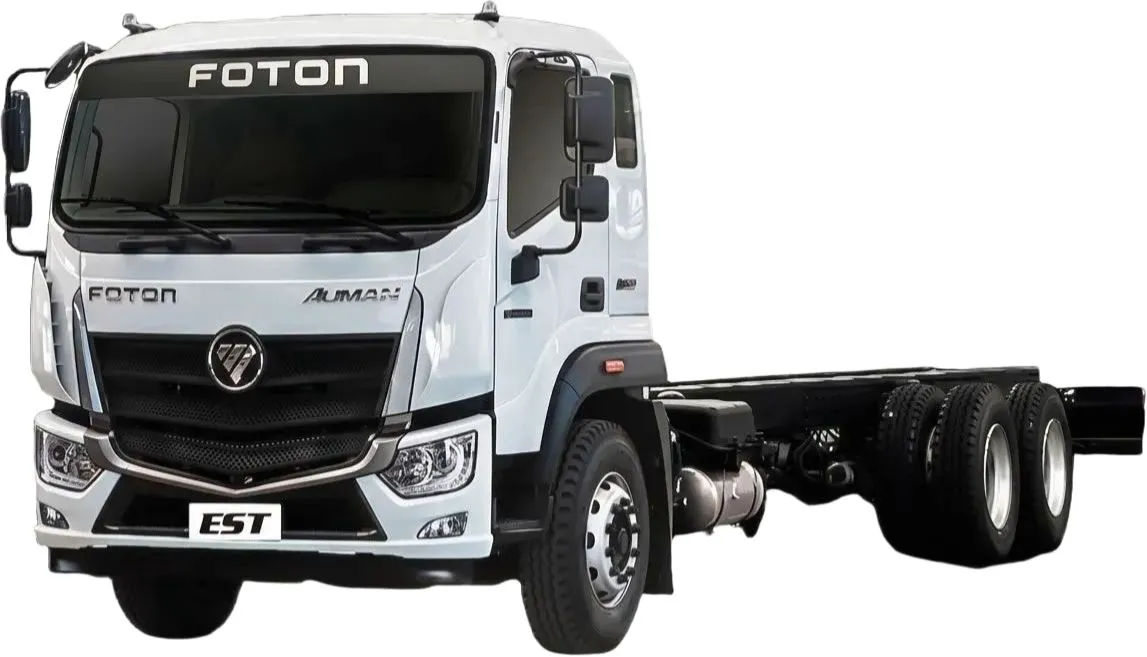
Two Foton Auman natural-gas 6×4 tractors. Both run the Cummins A15N family. Both are high-roof long-haul machines. One is $70,000 and one is $80,000, and the $10,000 buys you three things: 50 horsepower, an automatic gearbox, and a much better cab.
Whether that is a good trade depends almost entirely on one question about your operation, which we will get to. First, what is actually different.
A note on sourcing before we start: the Auman EST 530 LNG publishes a full chassis and driveline specification. The Auman Galaxy 580 NG publishes a model price list and a detailed equipment and comfort description, but no chassis parameter table. We will be explicit about which figures are published and which are not.

| Item | EST 530 LNG (#54) | Galaxy 580 NG (#2) |
|---|---|---|
| Price | $70,000 | $80,000 |
| Drive | 6×4 | 6×4 |
| Engine | Foton Cummins A15NNS6B530 | Foton Cummins A15N |
| Displacement | 14.5 L | not published |
| Power | 390 kW / 530 hp | 580 hp |
| Torque | 2,500 Nm (product description) | not published |
| Rated speed | 1,900 rpm | not published |
| Fuel | LNG | NG (natural gas) |
| Emission | National VI | not published |
| Gas cylinder | 1,000 L (1,350 L optional) | not published |
| Gearbox | ZF 16S2531TO, 16-speed manual | ZF automatic, high torque |
| Housing material | Aluminium alloy | not published |
| Wheelbase | 3,825 + 1,350 mm | not published |
| Dimensions | 7.49 × 2.5 × 3.75 m | not published |
| Kerb weight | 8.805 t | not published |
| GVW | 25 t | not published |
| Max towing weight | 40 t | not published |
| Top speed | 89 km/h | not published |
| Front axle | 6.5 t (7,000 kg) | not published |
| Rear axle | 469 double-layer (18,000 kg) | not published |
| Spring count | 3/5 | not published |
| Fifth wheel | 50# | not published |
| Tyres | 12R22.5 18PR, 10 tyres | not published |
| ABS | Yes | not published |
| Hydraulic retarder | Standard | not published |
| Cab | High roof, standard floor | High roof |
| Bunk width | Upper 578 mm / lower 880 mm | 1,010 mm ultra-wide sleeper |
| Air conditioning | Automatic | PM2.5 filtration, new generation |
To be blunt: on published chassis data this is not a comparison, it is a one-sided disclosure. The EST tells you its wheelbase, weights, axles, tyres, fifth wheel and retarder. The Galaxy listing tells you its price, its cab and its features.
That does not make the Galaxy worse — it makes it harder to verify. If you are serious about the Galaxy, ask for the chassis parameter sheet before you sign.


The EST runs a ZF 16S2531TO — sixteen forward gears, two reverse, a manual shift, in an aluminium housing. The Galaxy runs a ZF automatic described as high-torque, operated by a knob-type AMT shift device.
For a long-haul LNG tractor, sixteen manual gears is a genuinely excellent answer. Sixteen ratios let you hold the engine in its narrow efficient band across a wide range of speeds and loads, which on a gas engine matters more than on a diesel because the torque curve is different. An experienced driver will extract superb fuel economy from it.
An automatic is the better answer under three conditions: your drivers vary in skill and you want to remove that variance; your routes involve heavy traffic or frequent stopping; or you struggle to recruit and retain experienced drivers. It also reduces clutch and driveline wear caused by bad shifts.
Against that: an automatic costs more to repair, needs diagnostics equipment, and in a remote area a manual can often be limped home when an automatic cannot.
If your drivers are career professionals on open highway, sixteen manual gears is not a compromise. If your fleet turns drivers over, the automatic pays for itself in avoided clutch and driveline damage.
530 against 580, both from the Cummins A15N family. The EST publishes 390 kW at 1,900 rpm and the product description quotes 2,500 Nm. The Galaxy does not publish power or torque figures for this specific model.
On a tractor rated to 40 tonnes towing, 530 hp is ample for most work. The extra 50 buys you faster grade recovery and the ability to hold a higher gear on a climb — which matters if your route is mountainous or if you consistently run at the top of the weight limit. On flat highway it will rarely be the difference.
If your routes are flat and your loads are consistent, do not pay for horsepower you will not use. If you run mountain passes, it is worth having.
The EST product material makes an unusually concrete fuel claim: approximately 31 kg of LNG per 100 km, saving over $0.27 per mile against a comparable diesel, which it puts at nearly $1,370 on a 3,000 km trip and more than $41,100 a year.
Treat manufacturer fuel claims as directional rather than contractual — your actual consumption depends on load, terrain, speed and driver. But the direction is real: where LNG is meaningfully cheaper than diesel per unit of energy, a gas tractor pays back its premium, and where it is not, it does not.
That makes the gas cylinder capacity a specification that matters. The EST publishes 1,000 litres with a 1,350-litre option. Range on LNG is the single biggest operational constraint for a gas tractor, because you cannot carry a jerry can of it. The Galaxy does not publish a cylinder figure — ask for it, and ask for the refuelling network along your routes before you commit either truck.
One thing the EST has that is easy to overlook: a hydraulic retarder as standard. On a 40-tonne combination, a retarder saves service brakes on long descents and is a genuine safety item. The Galaxy listing does not mention one.
This is where the $10,000 is most visible, and the listing is detailed.
The Galaxy offers a knob-type AMT shifter described as a first in the heavy truck industry, 10-inch and 12.3-inch dual LCD screens, a PM2.5 filtration air conditioning system, one-button start, a four-function multifunction steering wheel with Bluetooth, cruise and multimedia controls, Carlife phone mapping, an electronic parking brake, a 1,010 mm ultra-wide sleeper, a new dashboard and a foldable passenger table, with an optional all-in-one catering device and optional ACC adaptive cruise.
The seats are specified with massage, front and rear shock absorption, adjustable seatbelt height, shoulder adjustment, ventilation and heating. Externally there is a "Galaxy Starwing" grille with diamond-cut mesh and blue light guide strips, and "Galaxy Matrix" LED automatic headlights in a six-tube array.
The aerodynamics claim is specific and worth money: the standard cargo box reduces the drag coefficient by 7.2% and gas consumption by 2.4%, while the enlarged cargo box achieves a 12% drag reduction and 4% lower gas consumption. On a vehicle burning 31 kg of LNG per 100 km, 4% is a real number.
The EST is not spartan by any means — automatic air conditioning, electric windows and mirrors, remote key, a multifunction steering wheel, GPS/Beidou recording, an air-suspension driver seat, electric cab lift, halogen headlights, a deflector and an integrated mudguard, with a 578 mm upper and 880 mm lower bunk. But the Galaxy is clearly the more modern cab.
you want published, verifiable chassis data now; your drivers are experienced and prefer a manual; you want the 1,000 L or 1,350 L cylinder for range; you want a hydraulic retarder as standard; your routes are not mountainous; and $70,000 is your budget.
you want the automatic; driver comfort and retention are commercial priorities for you; you want the aerodynamic package and the gas consumption saving; your routes involve grades where 580 hp helps; and you are prepared to obtain the missing chassis parameters before signing.
And regardless of which you pick: confirm the LNG refuelling network along your actual routes before you buy either truck. That single check determines whether a gas tractor is an asset or a problem.

On published information: 580 hp against 530, a ZF automatic against a 16-speed manual, and a substantially more advanced cab with dual screens, massage seats, a 1,010 mm sleeper, EPB and an optional ACC.
Yes for most work. The EST publishes a 40 t maximum towing weight with 390 kW and a quoted 2,500 Nm. The extra 50 hp on the Galaxy helps most on sustained grades.
The EST publishes a 1,000 L cylinder with a 1,350 L option and claims roughly 31 kg of LNG per 100 km. The Galaxy does not publish a cylinder capacity — ask for it.
The EST lists a hydraulic retarder as standard. The Galaxy listing does not mention one. Confirm before ordering.
Not from the published listing, which contains a model price list and equipment description but no chassis parameter table. Request the full specification sheet from the supplier before committing $80,000.
530 hp LNG tractor
Foton Auman EST 530 6×4 LNG Truck Tractor
$70,000 · 530 hp · Cummins A15N 14.5 L · ZF 16-speed · 1,000 L gas · Retarder
View full specification580 hp NG tractor
Foton Auman Galaxy High-roof 6×4 NG Tractor
$80,000 · 580 hp · Cummins A15N · ZF automatic · Galaxy cab · 1,010 mm bunk
View full specification

Tel:+8615960378211
Email:[email protected]
Address: Unit 8,room 704,NO.492,XingLinWan Road,Jimei District,XiaMen Fujian China
Address: Unit 8,room 704,NO.492,XingLinWan Road,Jimei District,XiaMen Fujian China
Email:[email protected]
© Authorized Dealer of FOTON AUMAN 2026 All Rights Reserved, Auman truck is a commercial vehicle brand under the Foton Daimler
Privacy policy