Writer:Alan Chen(Foton Auman dealer)
A quarry haul road does not wear a truck out gently. Laterite that turns to slurry once the rains arrive, granite dropped in by an excavator whose bucket is wider than the box, a ramp graded on Monday and rutted by Friday — and an operator whose margin is decided by how many loaded passes the truck completes between first light and the shift change. When you specify a tipper for that work, the two figures that move your cost per tonne are not on the front of the brochure: they are the struck volume of the body in cubic metres and the final drive ratio behind the axle.
This article is about one job only: mining and quarry haulage in Nigeria. Four listings in the Foton Auman GTL-E dump range are configured for that job — three 6×4s and one 8×4 — and every number quoted below is taken from the parameter table published with each listing. Where the table is silent, I say so, because that silence is usually the thing that costs you money later.

Three of the four trucks are, on paper, the same machine. All three carry the GTL-E platform, a wheelbase of 3,825 + 1,350 mm, a Foton Cummins ISG12 of 11,800 cc rated at 294 kW / 400 PS at 1,900 rpm, 2,100 Nm at 1,000 rpm, a Sinotruk HW23712 iron-case 12-speed (written as HW-12MT in the headline) and a final drive of 4.76. The announcement model on two of them is identical: BJ3259DLPKB-1.
Read the rpm carefully. Peak power at 1,900 rpm tells you what the truck does once rolling; 2,100 Nm available from 1,000 rpm tells you what it does standing at the bottom of a ramp with 14 cubic metres behind the headboard. On a haul road, launch torque is consumed every cycle and top-end power almost never. A 12-speed manual with a deep first gear plus that torque means the driver is not riding the clutch — and clutch life on a quarry fleet is a line item, not a detail.
Where the three diverge is not the driveline. Two list ABS and front-and-rear air brakes with a flat-top cab and automatic air conditioning as standard. The third, listed as a muck truck for West Africa, describes a short sleeper cab, a mid-length body, drum brakes front and rear, and ABS as optional. Same engine, gearbox and 4.76 ratio — a different specification sheet, and the first thing to pin down before you compare prices.
Multiply the body dimensions on the 6×4 and you get 5.6 × 2.3 × 1.1 — roughly 14.2 cubic metres struck. Multiply the 8×4 body at its shorter listed length, 7,800 × 2,300 × 1,500 mm, and you get about 26.9 cubic metres; at the longer listed length of 8,000 mm it is 27.6 cubic metres. That is close to double the material per cycle, and on a haul road where cycle time is dominated by loading and tipping rather than by driving, volume per pass is the number that decides how many trucks you need to buy.
There is a penalty. The 6×4 chassis is 7,500 mm long; the 8×4 is 10,600 or 10,800 mm depending on body length. On a pit floor with a tight turning bowl at the face, 3 metres of extra vehicle costs manoeuvring time and access to faces a shorter truck can work. The 8×4 also stands 3,580 mm tall against 3,400 mm — relevant if the route passes under a gantry.
One honest gap: none of the four publishes a kerb weight or a declared payload — the tables give gross figures and body dimensions only. If you are costing tonnes per shift, get the tare weight in writing for the exact body you order, because floor plate and wear liners come straight off the payload.

The two configurations share a great deal: the same 11,800 cc ISG12 family, the same Sinotruk HW23712 iron 12-speed, the same 9 T front axle rating, the same 16 T middle/rear axle rating, the same 350-litre aluminium alloy fuel tank, the same 13R22.5 18PR tyres, the same leaf spring suspension, the same air brake system and the same two-seat cab. What separates them is the axle ratio and the geometry.
The 6×4 runs 4.76. The 8×4 runs 5.26. That is a meaningful step: the 8×4 is geared lower, which is what you want when the truck is leaving a loading face with a much bigger load on a surface that has no grip. It also has 13 wheels against 11 and a wheelbase of 1,800 + 4,300 + 1,400 mm against 3,825 + 1,350 mm, which spreads the load over more contact patches — useful where the road is soft, and something to check against your own axle-load limits before you commit.
The outputs differ too. The 8×4 declares 316 kW / 430 PS at 1,900 rpm and 2,200 Nm at 1,000 rpm; the 6×4 declares 294 kW / 400 PS and 2,100 Nm — 30 PS and 100 Nm, arriving at the same 1,000 rpm. Against roughly twice the box volume, that extra output has more to do per cubic metre.
Every listing in this group carries a tonnage headline — 70 T on the 6×4s, 80 T on the 8×4 — and every listing also carries a separate pair of gross figures in its parameter table. The 6×4s declare GVW 25,000 kg and GCW 70,000 kg. The 8×4 declares GVW 31,000 kg and GCW 80,000 kg. Those are different quantities, and conflating them is how fleets end up with a truck that cannot legally carry what the brochure implied.
There is a useful check on the 6×4: 9 T front plus 16 T middle/rear sums to 25 T, matching the declared GVW exactly. On the 8×4 the same two figures — 9 T front, 16 T middle/rear — are listed against a declared GVW of 31,000 kg, and the table does not say where the remaining capacity sits. Ask the seller for per-axle ratings in writing and check them against your local axle-load limits before the deposit moves.
All four listings in this group are published without a Euro badge. Three of them state “No emissions” in the emission field with an emission route of “/”; the fourth states “No Emission Requirements”. Not one of the four declares Euro II, III, IV, V or VI.
That is a specification choice that has to be matched to the paperwork your import is processed under. If your import permit or registering authority requires a stated emission standard, none of these four as listed provides one — establish it before agreeing a price, not after the ship sails. Ask for the engine’s emission declaration document, not a verbal confirmation.
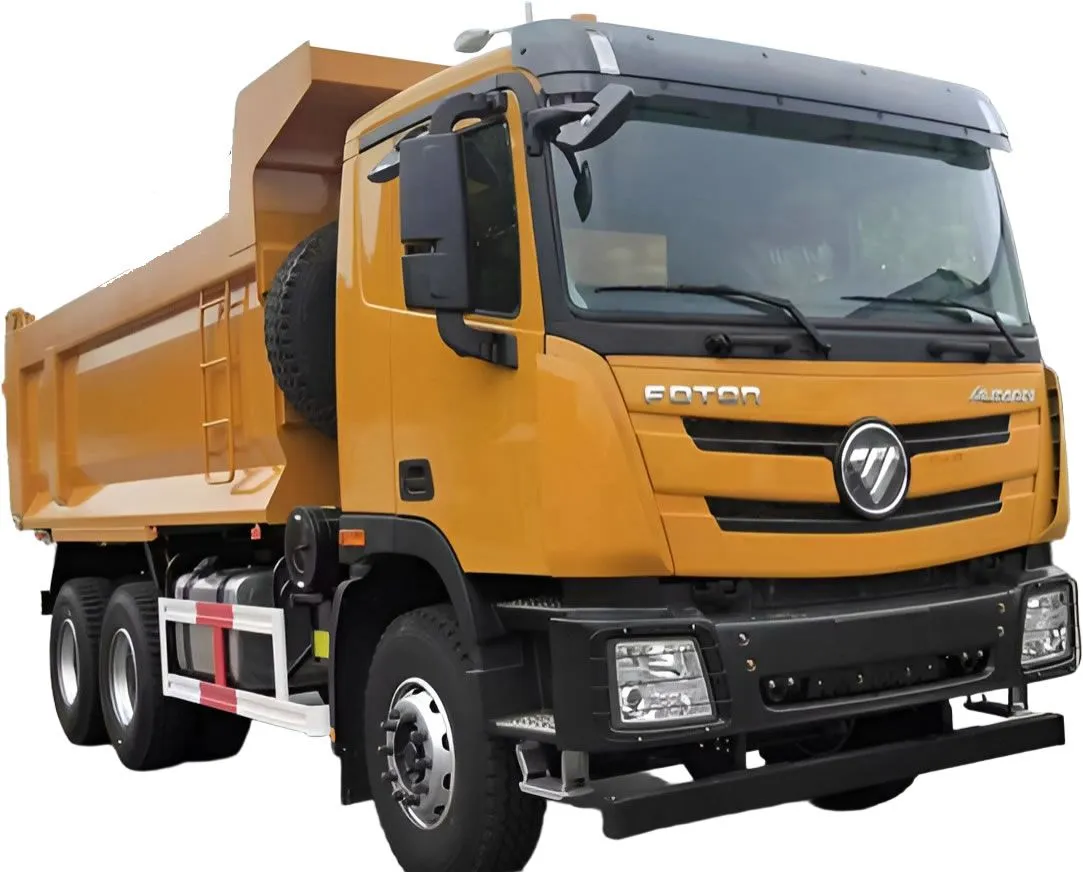
On a quarry fleet, driver turnover is rarely decided by the engine. Three of the four list automatic air conditioning, electric doors and windows with central locking and an airbag seat as standard; the 8×4 adds remote lock and five locks. The fourth listing publishes no air conditioning line at all, so treat cabin air there as an open question.
Fuel capacity is 350 litres of aluminium alloy on all four — identical on the 6×4 and the 8×4. On a pit with no refuelling point, that defines how much of the shift the truck works before it returns to the bowser, so ask about a larger tank at quotation stage if your haul is long.
Tyres are 13R22.5 18PR mixed/drive across the group — 11 on the 6×4, 13 on the 8×4 — with a family of options listed. On sharp granite fines, tread and ply rating are worth more than any electronic feature, so choose deliberately. Behind it all sits a frame section of 225/320 × 90 × (8+7) mm, which is what decides whether the chassis survives a careless excavator.
| Listing | Drive | Power / torque | Final drive | Body (mm) | GVW / GCW | Price |
|---|---|---|---|---|---|---|
| GTL-E 6×4 engineering truck | 6×4 | 400 PS / 2,100 Nm | 4.76 | 5,600 × 2,300 × 1,100 | 25,000 / 70,000 kg | $46,550 |
| GTL-E 6×4 bulk materials | 6×4 | 400 PS / 2,100 Nm | 4.76 | 5,600 × 2,300 × 1,100 | 25,000 / 70,000 kg | $54,520 |
| GTL-E 6×4 muck truck | 6×4 | 400 PS / 2,100 Nm | 4.76 | 5,600 × 2,300 × 1,100 | 25,000 kg GVW | $42,883 |
| GTL-E 8×4 80 T | 8×4 | 430 PS / 2,200 Nm | 5.26 | 7,800 / 8,000 × 2,300 × 1,500 | 31,000 / 80,000 kg | $58,520 |
Nigeria enforces axle-load limits under the ECOWAS harmonised standard, which the Federal Road Safety Corps (FRSC) and the Federal Ministry of Works apply at weighbridge stations. The statutory maxima are 10 t on a single steering axle, 18 t on a tandem group and 24 t on a tridem, with gross combination weight for a standard six-axle articulated rig capped between 50 t and 55 t depending on the route’s bridge classification. Enforcement is uneven: weighbridges on many federal corridors are still being brought back into service, and the FRSC has historically watched passenger vehicles more closely than axle loads, so overloaded rigs remain common. The roads punish what the law allows — the Lagos–Ibadan Expressway and the Oshodi–Apapa access road are the two worst bottlenecks, and a truck that is legal at 55 t still has to survive hours of stop-start crawl into Apapa before it earns anything.
For a tipper the binding constraint is the haul from the pit to the trunk road, where the FRSC weighbridge is the point where an over-loaded unit collects its fine — and port-to-hinterland freight runs through here, so the box that fills to the headline weight on site can be over the axle caps before it reaches the highway.
Whatever Foton is selling in Nigeria is being sold against a used Japanese truck, and that is the comparison that decides the deal. Isuzu, Hino and Mitsubishi Fuso dominate the second-hand market, joined by the newer Chinese entrants — Sinotruk Howo and Shacman in the heavy end — plus Tata and Ashok Leyland on lighter rigid work. The used Japanese truck wins on familiarity and spare-part density but loses on age, odometer honesty and the rebuild cost that arrives within a year or two. The Chinese new truck wins on warranty and a clean bill of health but has to build a service footprint that is still thinner than the Japanese network. Foton sits deliberately in the middle, which is exactly the pitch a fleet buyer with a real TCO spreadsheet wants to hear.
Two listings, one announcement model, $7,970 apart. The $46,550 and $54,520 6×4 entries both carry announcement model BJ3259DLPKB-1 and identical driveline figures. Either the two listings differ in body or cab specification in a way the tables do not show, or one of them is mispriced. Get the difference in writing.
Resolve what the 70 T and 80 T badges refer to. The tables declare GVW 25,000 kg (6×4) and 31,000 kg (8×4) alongside GCW 70,000 and 80,000 kg. Ask which figure applies to the vehicle as it will be registered in your name, then check it against your local axle-load limits.
Confirm the 8×4 axle distribution. Front 9 T and middle/rear 16 T are listed against a GVW of 31,000 kg; the arithmetic does not resolve from the published table, so request per-axle ratings before ordering.
No Euro standard is declared on any of the four. If your import permit requires a stated emission standard, confirm this line before you order — none of these listings provides one as published.
ABS is standard on three listings, optional on the fourth. The muck truck marks ABS optional and specifies drum brakes front and rear; the others list ABS and air brakes. On a wet laterite ramp that is not cosmetic.
350 litres is the tank on every configuration. Aluminium, and identical across the 6×4 and the 8×4. If your shift is longer than one tank, ask about a larger option at the quotation stage rather than retrofitting later.
All four are listed as complete vehicles with named announcement models, which is what makes per-unit import realistic rather than a kit build. The quoted prices are listing figures — a starting point for enquiry, not a landed cost, with freight, duties and local bodywork on top. Work out the body volume you need per cycle first, pick the ratio that matches your ramp, then let the price settle itself.


Tel:+8615960378211
Email:[email protected]
Address: Unit 8,room 704,NO.492,XingLinWan Road,Jimei District,XiaMen Fujian China
Address: Unit 8,room 704,NO.492,XingLinWan Road,Jimei District,XiaMen Fujian China
Email:[email protected]
© Authorized Dealer of FOTON AUMAN 2026 All Rights Reserved, Auman truck is a commercial vehicle brand under the Foton Daimler
Privacy policy