Writer:Alan Chen(Foton Auman dealer)
If you run a quarry or an open-pit operation in Angola, the truck that breaks your budget is rarely the one that fails on the ramp. It is the one that was specified on advertised horsepower instead of on axle rating, final drive and body volume. A 400 PS badge tells you almost nothing about whether a machine can pull a loaded 5,600 mm box up a wet haul road all day without cooking a clutch or cracking a spring pack.
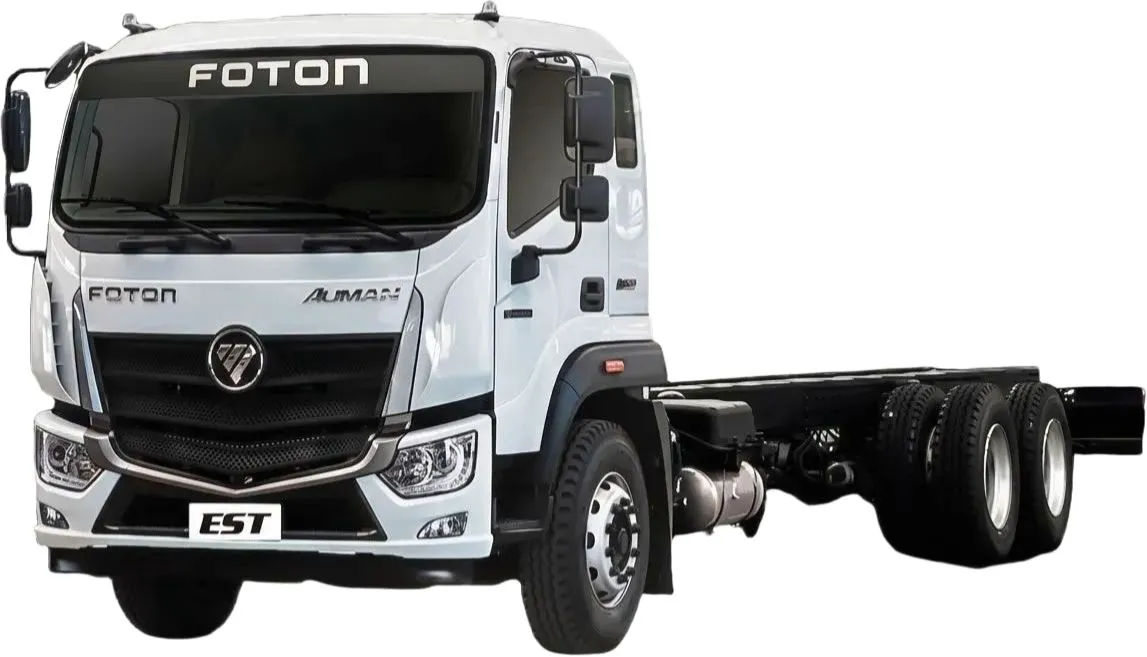
This article deals with one job only: mining and quarry haulage in Angola. It covers the three Auman GTL-E tippers currently configured for this work — two 6×4 70-tonne machines and one 8×4 80-tonne machine. Every figure below comes straight from the listing sheet, and where the sheet contradicts itself, we say so rather than smooth it over.

All three trucks run the Foton Cummins ISG12, 11,800 cc. The 70-tonne 6×4 pair delivers 294 kW / 400 PS at 1,900 rpm with 2,100 Nm at 1,000 rpm. The 80-tonne 8×4 makes 316 kW / 430 PS at 1,900 rpm with 2,200 Nm at 1,000 rpm. The 8×4 therefore has 30 PS and 100 Nm more to move a heavier gross combination — which is exactly the extra you would expect, and not much of a margin.
The more consequential number is the drive axle ratio. Both 6×4 trucks are listed at 4.76; the 8×4 is listed at 5.26. The 8×4 is the lower-geared machine, which suits a laden start on a soft floor and a steady climb. The 4.76 pair will run at lower engine speed for the same road speed, which reduces fuel burn and noise on long flat hauls. If your pit has a single steep ramp out and everything after it is flat, the 4.76 trucks are the more economical choice; if the loaded leg is the whole journey, the 5.26 ratio earns its keep.
Both ratios are paired with a Sinotruk HW23712 iron 12-speed manual. That is a manual, not an automated box, and it is worth saying plainly: on a repeated stop-start quarry cycle with a heavy train, driver technique still matters. The listing also declares a GCW of 70,000 kg for the 6×4 trucks and 80,000 kg for the 8×4, against a GVW of just 25,000 kg and 31,000 kg respectively. Those two numbers do not describe the same thing — one is the gross vehicle weight and the other is the gross combination weight — so confirm with the dealer which rating your registration and plating will actually be issued against.

Listings id=80 and id=82 are, on the specification sheet, the same truck: both 400 PS, both 6×4, both 3,825 + 1,350 mm wheelbase, both a 5,600 × 2,300 × 1,100 mm body, both a 9 t front axle and 16 t middle/rear axle group, both an 11-wheel 13R22.5 18PR layout, both a 350 L aluminium tank, both the HW23712 gearbox, both homologated under announcement model BJ3259DLPKB-1, both rated 70 T. The only visible difference is price: $46,550 against $54,520.
That gap is roughly $8,000 for what the sheets describe as one machine, so ask the dealer to justify it line by line before you choose. In practice the difference is usually in the optional equipment code blocks — tyre brand, body combination code, and whether the truck ships with the automatic air conditioning listed as standard. Get that in writing.
One further note that applies to all three trucks: the emission field on these listings reads “No emissions” with an empty emission route. That is not a real standard and it is not a typo you can ignore — it means the sheet does not state a homologated emission level for this configuration. If your import permit or your site licence requires a declared Euro standard, you must resolve this in writing before ordering. Do not assume.
Work from the internal dimensions, not the tonnage badge. The two 6×4 trucks carry a 5,600 × 2,300 × 1,100 mm box. The 8×4 carries a box listed as 7,800/8,000 × 2,300 × 1,500 mm — the two figures describe the two body options available on that chassis.
| Specification | GTL-E 6×4 (id 80 & 82) | GTL-E 8×4 (id 81) |
|---|---|---|
| Power / torque | 400 PS · 2,100 Nm @ 1,000 rpm | 430 PS · 2,200 Nm @ 1,000 rpm |
| Final drive ratio | 4.76 | 5.26 |
| Body volume | 5,600 × 2,300 × 1,100 mm | 7,800/8,000 × 2,300 × 1,500 mm |
| Wheelbase | 3,825 + 1,350 mm | 1,800 + 4,300 + 1,400 mm |
| Axle capacity | 9 t front / 16 t rear | 9 t front / 16 t rear |
| Wheels / tyres | 11 · 13R22.5 18PR | 13 · 13R22.5 18PR |
| Declared weight | GVW 25,000 kg · GCW 70,000 kg | GVW 31,000 kg · GCW 80,000 kg |
| Listed price | $46,550 · $54,520 | $58,520 |
The practical read is this: if your operation strips overburden, moves building materials or removes demolition waste in volume, the 8×4 carries a materially larger box on a longer three-axle platform. If your job is dense ore or slag on a defined haul route, the 6×4 with the 4.76 ratio will do the same work with two fewer tyres to buy and a shorter turning circle on a tight bench.
All three trucks are flat-top cab, two seats, automatic air conditioning as standard, with electric doors and windows, central locking and an airbag seat listed in the standard body assembly. The 8×4 adds a remote lock and a five-lock set. Braking on every unit is air brake with ABS. Suspension is leaf spring across the board, and the frame section is identical at 225/320 × 90 × (8 + 7) mm.
Fuel capacity is 350 litres of aluminium tank on all three. That is the same tank on a 400 PS 6×4 and on a 430 PS 8×4 doing more work. On a site where refuelling happens once a shift that is fine; on a remote pit with a long haul cycle, plan your fuel logistics around it rather than assuming a bigger tank will be substituted.
Angola is an oil economy rebuilding its road network after decades of conflict, and its axle-load limits follow the SADC framework — a single-axle limit around 10 t, a tandem limit of 18 t and gross combination weight near 56 t — but enforcement is uneven outside the Luanda–Lobito corridor. Luanda port is the gateway for most imports, and the road east toward the interior is where a truck earns. The practical constraint is often the road condition and the availability of parts rather than the weighbridge, so a durable, simple spec beats a complex one.
For a tipper the binding constraint is the haul from the pit to the trunk road, where the road authority weighbridge is the point where an over-loaded unit collects its fine — and post-conflict reconstruction freight runs through here, so the box that fills to the headline weight on site can be over the axle caps before it reaches the highway.
In Angola the reference vehicle is a used Japanese truck — Isuzu, Hino and Mitsubishi Fuso dominate the second-hand market — with Sinotruk Howo and Shacman strong in the heavy end and a large used import fleet. The used Japanese truck wins on parts density but loses on age and the rebuild cost that lands within a couple of years. The new Chinese truck wins on warranty and a clean bill of health. Foton’s pitch is that middle ground, and in a market rebuilding its fleet it is a credible new-truck option.
Resolve the emission field in writing. All three sheets state “No emissions” with no emission route. That is not a homologated standard. If your import permit requires a declared Euro level, get the actual certificate before you pay a deposit.
Clarify GVW against GCW. The 6×4 trucks are listed with GVW 25,000 kg and GCW 70,000 kg; the 8×4 with 31,000 kg and 80,000 kg. Confirm which rating appears on the plate and which one your local axle-load rules will be applied to.
Justify the $8,000 spread on the two 6×4 trucks. Listings 80 and 82 describe the same 400 PS, 6×4, 4.76-ratio 70 T specification. Ask for the itemised difference in tyres, body option code and cab equipment.
Match the final drive to your haul profile. 4.76 for flat, long haul roads; 5.26 if the loaded leg is the climb. Ordering the wrong ratio is the most expensive mistake available here.
Check tyre specification and spares. Every truck ships on 13R22.5 18PR in a mixed/drive pattern. Confirm your local supply can service that size before you commit a fleet to it.
Prices shown are the figures published on each listing and are a starting point for enquiry, not a landed cost — freight, duties and local bodywork sit on top. Match the specification to the haul road first, then argue about the number.


Tel:+8615960378211
Email:[email protected]
Address: Unit 8,room 704,NO.492,XingLinWan Road,Jimei District,XiaMen Fujian China
Address: Unit 8,room 704,NO.492,XingLinWan Road,Jimei District,XiaMen Fujian China
Email:[email protected]
© Authorized Dealer of FOTON AUMAN 2026 All Rights Reserved, Auman truck is a commercial vehicle brand under the Foton Daimler
Privacy policy