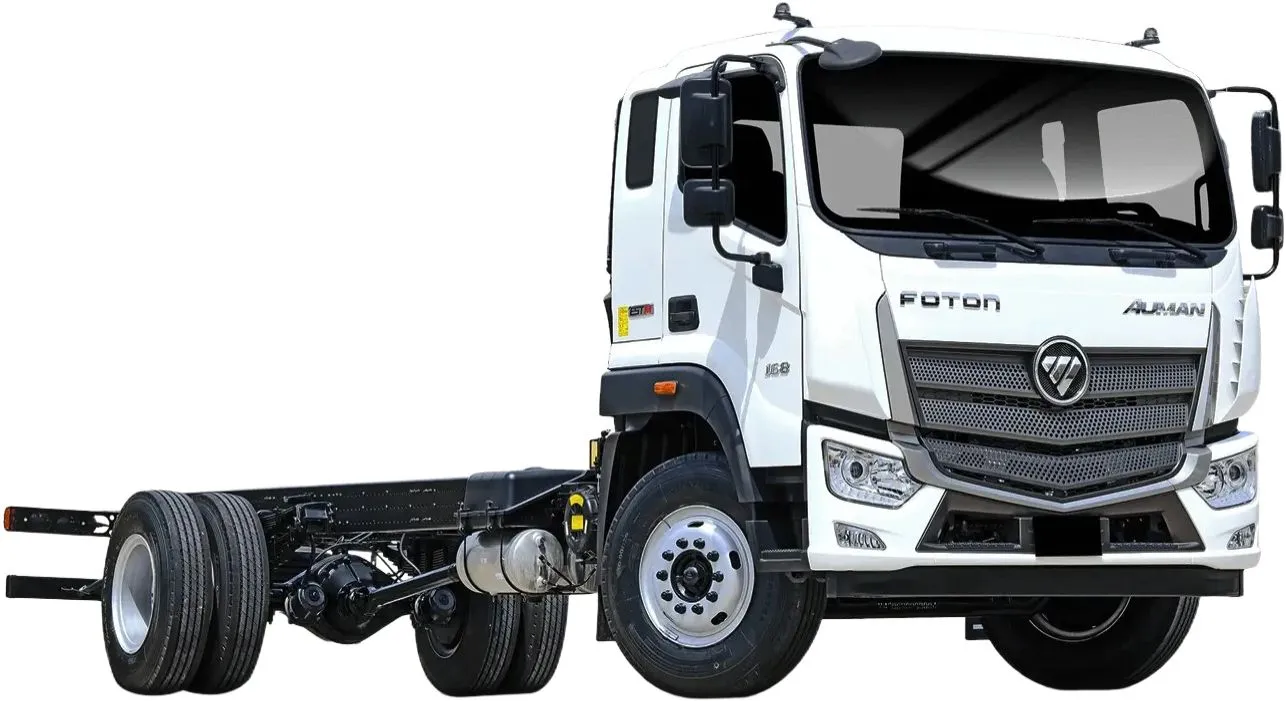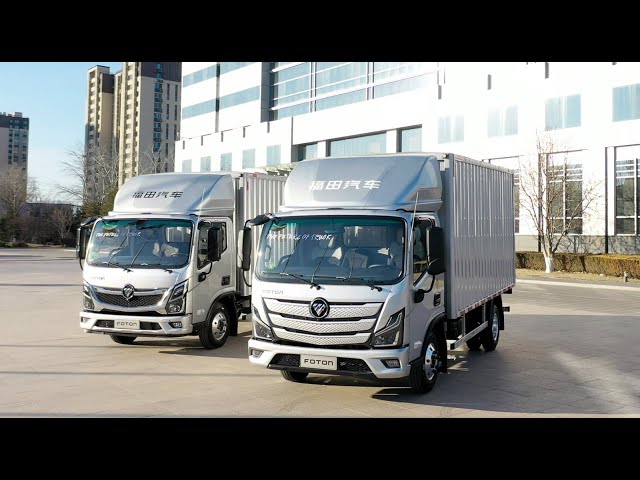


There is a point in every fleet where the biggest truck is not the best truck. Payload you never use is money spent on tyres, fuel, licences and driver categories you did not need. The Foton Aumark EST-M 18-tonne 4x2 cargo truck, announcement model BJ1186VLPHK-1, is built for operators who have worked out exactly where that point is. Homologated for Peru and cleared for Panama, Costa Rica, Honduras, El Salvador, Guatemala, Venezuela, Laos and Myanmar, it is supplied as a complete vehicle rather than a rolling chassis, so it goes straight into service. Its case is simple and deliberately so: an 18,000 kg gross vehicle weight, a 6,800 mm load bed, a 6.7-litre Cummins-derived engine with 950 Nm of torque, and a chassis tuned for the paved and semi-paved roads that carry most commercial freight in Latin America.
The 6,800 x 2,300 mm cargo body is the first thing a buyer should look at. At 6,800 mm it is longer than most 18-tonne rigids on the market, which means a full row of standard pallets with room left over for the awkward last one, while the 2,300 mm internal width keeps the whole vehicle down to an overall width of just 2,320 mm. That narrowness is a genuine commercial asset: it goes down lanes, through gatehouses and into older urban loading bays that a wider truck simply cannot enter. Low 600 mm side boards keep the bed accessible from either side by forklift or by hand, so loading does not depend on having a raised dock available at every stop.
Because this truck is specified for road work rather than for quarry work, its chassis is tuned differently from a heavier-duty sibling. A 4.2-tonne front axle and a 9-tonne rear axle are paired with a 234 mm frame section, and the suspension runs just three leaves at the front and a 4+3 pack at the rear. Fewer leaves means less interleaf friction, a more compliant ride over broken asphalt and expansion joints, and less transmission of shock into the load, which matters when you are carrying cartons, appliances or bagged product rather than rock. The chassis still carries the full 18,000 kg gross weight; it simply does it with less punishment for the cargo, the driver and the body.
Power comes from the ISDe245 30, a 6.7-litre inline-six from Dongfeng Cummins rated at 180 kW and 950 Nm of torque. In a truck at this weight, that torque figure is the number that changes the working day. It is what allows a loaded vehicle to pull away cleanly on an uphill junction, to hold a gear instead of hunting between ratios on a long climb, and to overtake without the driver having to plan the manoeuvre two kilometres in advance. Because the engine delivers its pulling power low in the rev range, drivers spend less time at high rpm, and that shows up directly in fuel consumption, in engine life and in how quiet the cab remains on a long shift.
That engine is matched to a Fast 8JS118TA-B eight-speed manual gearbox and a drive axle with a 4.556 final ratio. The ratio is the taller of the two commonly offered in this family, which tells you what the truck was designed for: sustained running at cruising speed with the engine turning over gently and quietly, rather than crawling up a gradient in first gear. The eight ratios give a driver enough range to handle a heavy start when needed, and for operators whose routes genuinely demand more low-speed pull, the optional large-ratio rear axle is available. Standard fitment, though, is optimised for the highway rather than the pit.
In daily use, that bias pays off immediately. For urban distribution, the 2,320 mm overall width and 5,150 mm wheelbase make the truck easy to place in tight streets and crowded yards, while the low-end torque means a driver making thirty or forty drops a shift is not working the gearbox at every set of lights. Standard central locking and power windows are small comforts that stop being small by the tenth stop of the morning. On the open road, the same vehicle settles naturally into intercity freight work: the air deflector fitted as standard reduces drag at cruising speed, the 200-litre fuel tank supports a full day of running without a mid-route fuel stop, and the taller axle ratio keeps engine revs down so a 400 km leg arrives with the driver still fresh.
Stopping is by a full air brake system with drum brakes front and rear and ABS as standard. At 18 tonnes, air brakes are the correct engineering answer: they give consistent pedal feel whether the vehicle is empty or fully loaded, and they resist fade on a long descent far better than a hydraulic system of comparable cost. ABS keeps the truck stable and steerable under emergency braking on wet, dusty or polished surfaces, which describes a great deal of the road network across Latin America and South-East Asia. Combined with a left-hand-drive layout purpose-built for right-hand-traffic markets, it gives a fleet operator a defensible safety position.
The cab is a flat-roof extended unit seating two, and the choice is more considered than it looks. The extended cab gives the driver somewhere to rest, eat and stow gear during a long day without stretching the vehicle to the length and the price of a full high-roof sleeper, while the flat roof holds overall height to 2,750 mm, which matters for covered loading bays, older industrial gates and low bridge clearances. Standard equipment covers manual air conditioning, an MP3 audio system, central locking and electric windows. None of it is luxurious; all of it reduces fatigue, and a less fatigued driver is a safer, more careful and more productive one.
The truck rides on 11R22.5 tubeless radial tyres as standard, seven in total, six on the ground and one spare. This is a specification aimed squarely at road running. Tubeless tyres run cooler than tube-type equivalents, they are lighter, and when they are punctured they lose air slowly rather than deflating suddenly, which usually means the driver can reach a repair shop instead of stopping on the shoulder. For a fleet running intercity freight day after day, where a roadside delay can cost more than the tyre itself, that behaviour is worth a great deal more than a small saving on the purchase price.
Where the duty cycle justifies a change, the options list covers it. Operators working on rougher access roads can move to 10.00R20 tube-type radials, which are cheaper to buy and easier to repair in remote areas, or to 275/80R22.5, 295/80R22.5 or 10R22.5 tubeless sizes to fine-tune gearing and load index. Electric air conditioning and an MP5 system with a multifunction steering wheel are available for drivers who spend long hours in high temperatures, and a manual windows and mirrors package is offered for fleets that prefer the simplest possible trim. That range matters to urban distribution operators, who often run mixed specifications across a single fleet.
The configuration is prepared specifically for left-hand-drive markets and for the operating conditions of the regions it is released in. Peru is the lead sales market, with Panama, Costa Rica, Honduras, El Salvador, Guatemala, Venezuela, Laos and Myanmar also covered, a spread that says something about how widely this chassis has been validated. Euro III emissions certification and a mechanically straightforward fuel system suit markets where fuel quality can vary and where the diagnostic infrastructure for the newest drivelines is thin. In and around a busy container port, the truck's narrow body and tight wheelbase make port cargo transfer between the terminal and an inland depot genuinely practical.
That adaptability is what turns a sensible truck into a profitable one. On a building supply run, construction material hauling of block, steel, pipe, tile and bagged cement suits the 6,800 mm bed and the 600 mm side boards, which let a crane or a small loader place the load from either side without a dock. In the export seasons that drive so much of Peru's freight demand, agricultural produce transport of crated asparagus, grapes, mangoes, avocados or coffee moves quickly from packing house to port, where the compliant suspension and the long bed protect both the cargo and the delivery window.
The commercial argument is straightforward. Utilisation, not peak capability, decides whether a truck makes money, and utilisation depends on how many different jobs the vehicle can accept. In a single week this chassis can run export boxes in port cargo transfer, deliver block and steel in construction material hauling, and move crates of fruit in agricultural produce transport. Those three peaks fall at different times of the year, so the truck that can do all three rarely sits idle, and an idle truck is the single most expensive asset any fleet owns.
The Foton Aumark EST-M 18-tonne 4x2 is not trying to win a specification contest. It is trying to be the truck that is available, economical and unbothered by the work it is given. A 6.7-litre Cummins-derived engine with 950 Nm, an eight-speed Fast gearbox, a taller 4.556 axle for relaxed cruising, air brakes with ABS, a narrow 2,320 mm body that goes where wider trucks cannot, and a cab built for real working days add up to a machine that earns rather than impresses. For operators in Peru and the eight other markets this configuration serves, that is exactly the value worth paying for.