Writer:Alan Chen(Foton Auman dealer)
A mixer truck is the most misunderstood vehicle on a construction site. Buyers compare drum volumes and horsepower and then discover, six months in, that the truck will not climb the ramp out of the batching plant loaded, or that it will not hold a slump on a forty-minute run to a pour. The mixer is not a dump truck with a barrel on the back. It is a chassis whose entire gearing is chosen around moving a full drum slowly, and around getting that drum to the pour before the concrete stops being concrete.
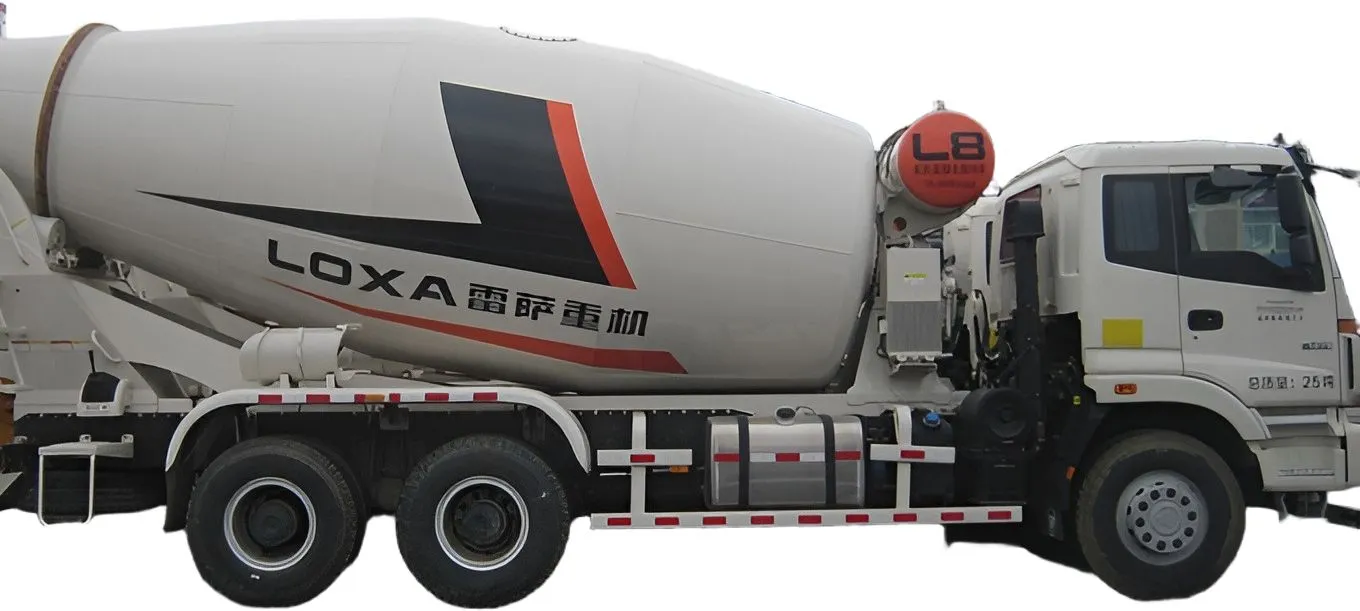
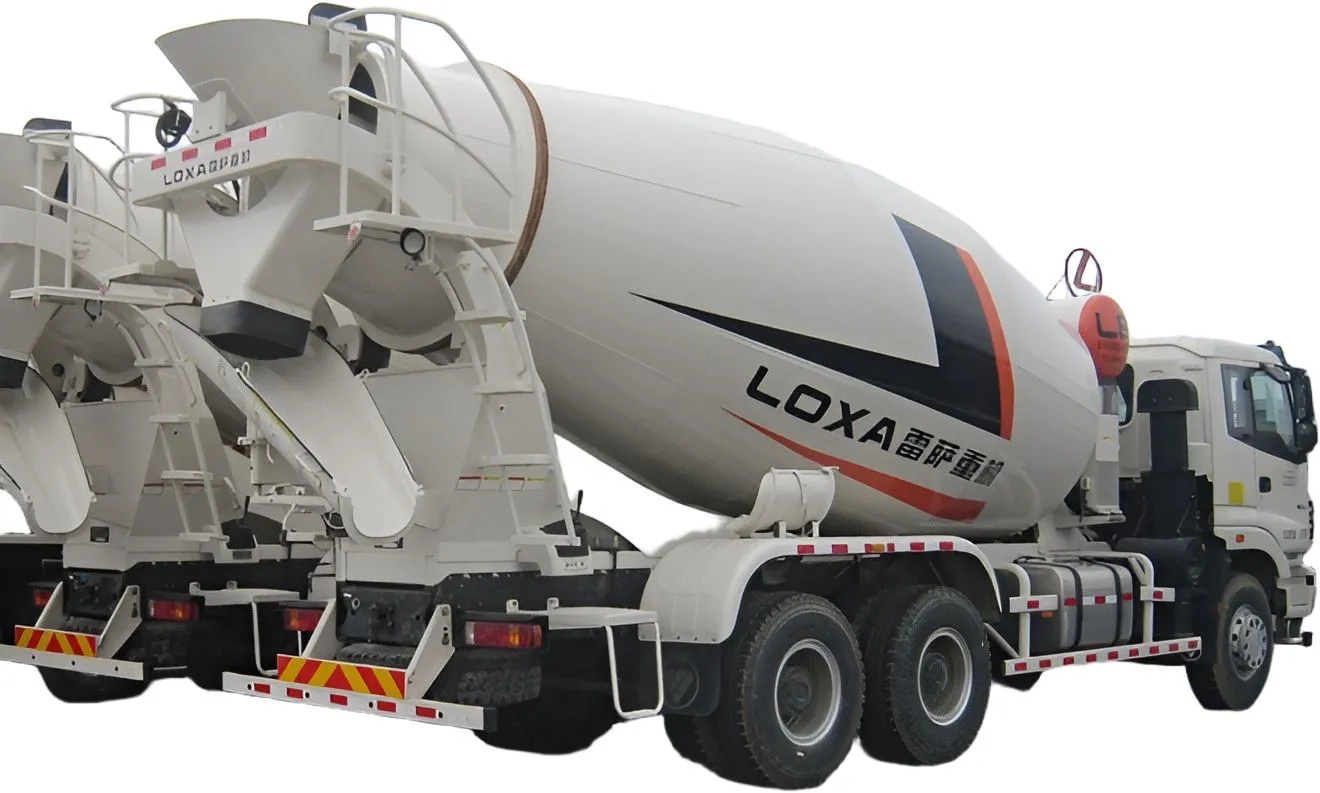
Only one mixer is configured for Ethiopia in this set, so this article is a deep dive on that single machine: the Foton Auman GTL 8×4 concrete mixer truck. Every number comes from its published specification, and where that specification leaves something open, it is flagged rather than filled in.
If you only retain one figure from this article, retain this one. The drive axle ratio is 5.73.
That is a very short, numerically high final drive, and on a 44-tonne mixer it is a deliberate choice with a clear meaning: this chassis is set up to move a full drum away from a plant, up a site ramp, and across unfinished ground, in low gears, without slipping the clutch or stalling. A numerically high ratio multiplies engine torque into wheel effort at low road speed. It is the opposite of a highway ratio.
The practical consequence is a rule you should apply when you plan routes. If your batching plant and your pour sites are close together — the normal pattern where one plant serves a cluster of sites within a few kilometres — 5.73 is exactly right and it will out-perform a longer-legged truck on ramps and on soft ground. If your work involves long road runs between plant and site at sustained speed, you will be turning the engine harder than necessary on every one of those runs, and you will pay for it at the fuel pump. There is no way to have both; the ratio is a permanent decision, so make it against your actual route mix.
Because the ratio is short, the gearbox matters more than usual. This truck carries a FAST 9JSD220TA, nine speeds. Nine ratios behind a 5.73 final drive gives a very low overall first gear for a loaded start on a gradient and enough splits to keep the engine productive on the move between sites. On a mixer, a nine-speed with a short final drive is a better combination than a six-speed with a long one, and it is a specification that has been chosen by someone who knows what a loaded drum does to a hill.
The engine is a Foton Cummins ISG12 at 11,800 cc, rated 400 PS with 2,100 Nm at 1,000 rpm. The emission standard is Euro IV, and the aftertreatment route is SCR.
Two of those numbers deserve attention. First, the torque figure is quoted at a single engine speed, 1,000 rpm, which is at the bottom of the working range. That is the right place for it to be quoted on a mixer, because it tells you the engine will pull from low revs with a full drum rather than needing to be revved. An engine that needs revs to make torque is a poor match for a vehicle that spends its day starting and stopping heavy.
Second, the 2,100 Nm figure is the same as that quoted for other 400 PS ISG12 applications, which suggests this is a standard rating rather than a mixer-specific one. That is normal and it is not a problem: what makes the mixer a mixer is the final drive and the body, not a unique engine map. But if a supplier quotes you a higher torque figure for this same truck, ask where it comes from.
SCR and a 350-litre aluminium alloy diesel tank complete the fuelling side. SCR means the truck uses a urea-based reagent to meet Euro IV, so your operation needs a reagent supply and your drivers need to understand what happens when the tank runs dry — a mixer that derates halfway through a pour is a very expensive afternoon. Plan a reagent stock the same way you plan diesel.
The truck is an 8×4 with a GVW of 44,000 kg on a wheelbase of 1,800 + 3,050 + 1,350 mm. Front axle capacity is 6.5 tonnes and the middle and rear axle capacity is 13 tonnes. There are 13 tyres on 315/80R22.5, described as a steering and drive specification in the V6 pattern.
An 8×4 on a three-part wheelbase is the standard configuration for a heavy mixer because it spreads a 44-tonne gross weight across four axle positions instead of three. That matters both for bridge and pavement loading and for the practical matter of not sinking a partially completed road. As with any heavy chassis, the declared axle capacities are group ratings, so if you are checking this truck against a local bridge formula, check it axle group by axle group rather than against the 44,000 kg figure alone.
The frame cross-section is given as 225/320 × 90 × (8+7) mm and the suspension is leaf spring. Braking is by air brake with ABS, which on a 44-tonne vehicle carrying a load that shifts as the drum turns is not optional equipment — it is the difference between stopping straight and not. The steering gear is an AM90L-S unit.

Here is the honest position on this listing, and it is worth stating plainly rather than working around.
The specification describes the vehicle as a mixer truck with a 44 T tonnage and a 44,000 kg GVW, and gives the complete chassis dimensions as 9,935 × 2,495 × 3,900 mm with a body width of 2,490 mm. What it does not give is the mixer-specific data a buyer actually needs to plan pours: there is no drum geometric volume, no mixing volume, no drum charging capacity, no water tank capacity, no chute configuration, no drum rotation speed and no discharge rate. The cargo box internal dimensions field is present but blank, which is expected on a special-purpose vehicle, but it means the body specification is simply not in this document.
This is not a criticism of the chassis specification, which is complete and coherent for what it covers. It is a warning about the shape of the purchase. On a mixer, the drum volume is the number that determines how many cubic metres you deliver per trip, and therefore your entire cost per cubic metre. If you buy this truck without a written drum specification, you have bought a 44-tonne 8×4 chassis with a mixer body of unknown capacity, and you will discover the capacity when the first load is batched.
Ask for the drum specification in writing, covering geometric volume, mixing volume, the water tank size and the discharge arrangement, and check the resulting payload against the 44,000 kg GVW. A full drum plus water plus fuel plus a three-person cab has to sit under that figure with the tare weight of the mixer body included, and on a heavy mixer that is a tighter calculation than most buyers expect. A mixer that can only be loaded to 70 per cent of its drum volume because of gross weight is a truck that will never earn what the specification sheet implied.
The cab side is straightforward. A flat roof, three seats, manual air conditioning as standard, power windows, central locking, a five-in-one lock, an airbag seat as standard and manual mirrors. Left-hand drive. Three seats is a genuine advantage on a mixer, because the third person is often the site contact or a second operator. The airbag seat matters on an unfinished site where a driver is being thrown around all shift.
The declared standard is Euro IV with SCR, and the approved model is BJ5319GJB-AF with a complete-vehicle status. Euro IV is a workable standard in a number of markets, but it is also the standard most commonly cited in import-approval questions, so confirm it against your permit before you go further. If your market requires Euro V or VI, this engine build will not satisfy it and the change is not a configuration option.
The sales country field on this listing reads General Countries. That is the least specific answer possible, and while it does not disqualify the truck, it does mean you have no documentary confirmation that this configuration has been approved for Ethiopia specifically. Since the chassis is being presented to you as an Ethiopian mixer, ask the supplier to state which market configuration will be built against your order and which approval document will accompany it. If a local approval is required, that answer should arrive before a deposit, not after arrival at the port.
The brand field reads Pumping Machinery, and the business line is Heavy Truck (H1). Both are catalogue classifications rather than buyer-relevant facts, but the brand field is worth a passing question if you are ordering under a specific brand or warranty expectation — the truck is a Foton Auman GTL on the GTL platform and the engine is a Foton Cummins unit, so the classification and the vehicle identity are not quite aligned in the sheet.
Ethiopia is landlocked and its truck fleets live on the Djibouti corridor — almost all seaborne cargo enters through the Port of Djibouti and is hauled up to the highlands, where Addis Ababa sits above 2,300 m and a naturally aspirated or under-spec engine loses power in the thin air. Axle-load rules follow the regional 56 t gross-combination framework, with a single-axle limit around 10 t and a tandem limit of 18 t, enforced by the Ethiopian Roads Administration on the main trunk roads. The altitude is the quiet spec killer: a truck bought for sea-level numbers under-performs on the climb to the capital, so the power-to-GCW ratio matters more than the badge.
For a mixer the constraint is the site access and the bridge limits on the way to the pour, where a full drum plus the chassis must stay inside the legal axle caps.
In Ethiopia the reference vehicle is a used Japanese truck — Isuzu, Hino and Mitsubishi Fuso dominate the second-hand market — with Sinotruk Howo and Shacman as the main Chinese competition and a growing local assembly sector. The used Japanese truck wins on parts density but loses on age and the rebuild cost that lands within a couple of years. The new Chinese truck wins on warranty but has to build a parts channel that is still thinner than the Japanese network. Foton’s pitch is the middle ground, and the altitude argument is one place where a fresh Chinese truck can beat a tired Japanese one.
Get the drum specification in writing. The listing gives you a 44-tonne chassis and no drum volume, water tank capacity, discharge rate or rotation speed. Those numbers determine your cost per cubic metre, so they belong in the quotation, not in a conversation.
Check the payload against the 44,000 kg GVW. Once you have the drum volume, work out full-drum mass plus water plus fuel plus the mixer body's tare and confirm it fits. A mixer that cannot be filled is a truck that cannot be paid for.
Confirm the 5.73 final drive suits your routes. It is excellent for close plant-to-site work and ramps. If a significant part of your duty is sustained road running, accept that you are buying a truck optimised for the other half of the job, and be sure that is the trade you want.
Plan a urea supply for the SCR system. Euro IV with SCR means a reagent consumption you must be able to service. Confirm the reagent tank capacity and plan a stock and a distribution arrangement for it as carefully as you plan diesel.
Resolve the sales country and the approval document. The listing says General Countries. Before you commit, establish which market configuration will be produced and what approval paperwork will accompany the vehicle into Ethiopia.
The chassis side of this truck is well argued. A 400 PS 11.8-litre engine making 2,100 Nm from 1,000 rpm, a nine-speed gearbox, a 5.73 final drive, an 8×4 layout with 6.5 tonnes on the front axle group and 13 tonnes on the middle and rear, thirteen 315/80R22.5 tyres and a 350-litre aluminium tank is a specification built around the reality of moving a full drum slowly and heavily. The listed $67,540 is a listing price rather than a landed cost, and freight, duty and any local work sit on top. Sort out the drum specification and the approval question first — then the rest of this truck is arithmetic you can trust.


Tel:+8615960378211
Email:[email protected]
Address: Unit 8,room 704,NO.492,XingLinWan Road,Jimei District,XiaMen Fujian China
Address: Unit 8,room 704,NO.492,XingLinWan Road,Jimei District,XiaMen Fujian China
Email:[email protected]
© Authorized Dealer of FOTON AUMAN 2026 All Rights Reserved, Auman truck is a commercial vehicle brand under the Foton Daimler
Privacy policy