Writer:Alan Chen(Foton Auman dealer)
A last-mile van earns money only while its load compartment is full and its driver is moving. Everything else is cost: fuel burnt idling outside a locked gate, the bay a long vehicle cannot use, the handover a driver loses because he cannot stand up in the back to sort parcels.
These two Foton vans are specified against different versions of that problem. The View CS2 is a 5.39-metre diesel box van built for narrow streets and tight bays at $19,680. The TOANO EV is a 5.99-metre battery-electric with 10.4 cubic metres of load space and a 260 km range at $34,000.
That is $14,320 of difference, and it is not a premium-versus-budget gap. It is two different answers to two different delivery problems.
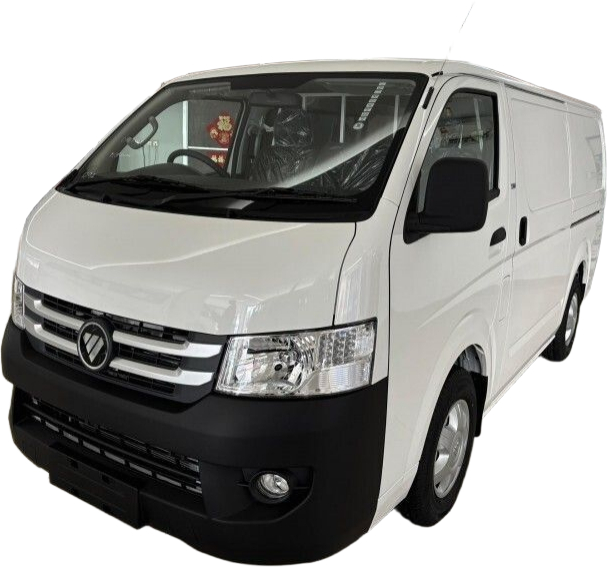
| Item | View CS2 (#230) | TOANO EV cargo (#211) |
|---|---|---|
| Price | $19,680 | $34,000 |
| Category | Medium VAN | Large electric VAN |
| Platform | VK1 | TOANO |
| Model | BJ5039XXY-ZA View CS2 | BJ5048XXYEVB |
| Dimensions | 5,390 × 1,920 × 2,285 mm | 5,990 × 2,000 × 2,495 mm |
| Wheelbase | 3,110 mm | 3,750 mm |
| Cargo box length | 5,380 mm | not published |
| Cargo volume | not published | 10.4 m³ |
| GVW | 3,400 kg | 4.2 t |
| Kerb weight | 2,020 kg | not published |
| Seats | 3 | 3 |
| Roof | High roof | not published |
| Drive side | Right-hand drive | not published |
| Engine / motor | Foton 4F20TC10, 2,000 cc | Permanent magnet synchronous |
| Power | 163 hp listed | 65 kW rated / 130 kW peak |
| Torque | not published | 150 Nm rated / 360 Nm peak |
| Emission | Euro IV | Zero tailpipe |
| Transmission | Zhongma ZM036 six-speed manual | None (electric drive axle) |
| Final drive | 4.556 | not published |
| Drive layout | 4×2 | Rear-mounted motor, rear-wheel drive |
| Battery | — | CATL LFP, 86.55 kWh, liquid cooled |
| Range | — | 260 km (CHTC) |
| Charging (20–100%) | — | 12.5 h AC / 0.8 h DC |
| Charging standard | — | GB |
| Max speed | not published | 120 km/h |
| Gradeability | not published | 20% |
| Ground clearance | not published | 160 mm |
| Axle payload F/R | not published | 1,750 / 2,500 kg |
| Brakes | Front disc, rear drum | Front and rear disc |
| Brake control | not published | ABS + EBD, ESC, EPB with auto-hold |
| Steering | not published | Electric power assist |
| Suspension | Front double wishbone with torsion bar, rear leaf | not published |
| Tyres | not published | 215/75R16C, steel wheels with hub caps |
| Air conditioning | not published | Electric, front A/C and heater |
| Market | Mauritius | Tajikistan |
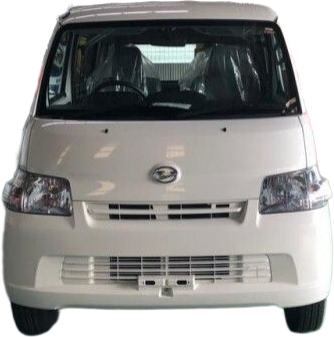
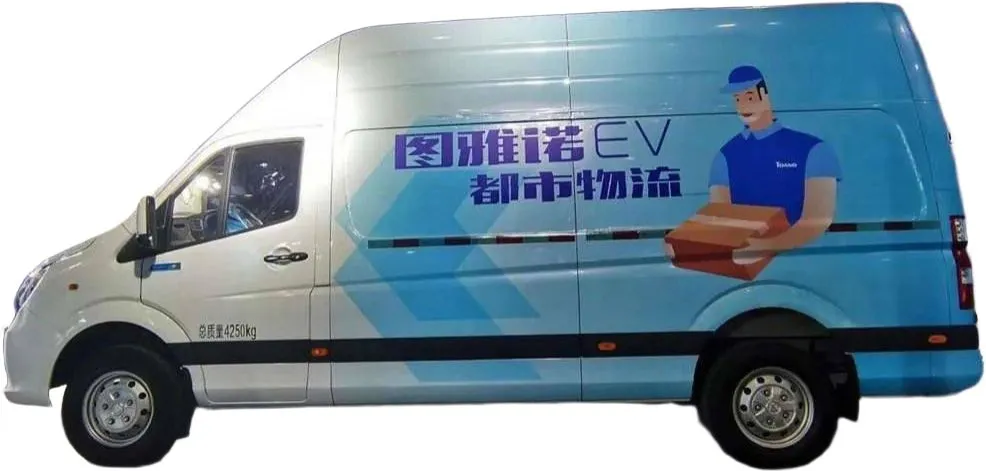
This is the crux, and the View CS2 specification reads like it was written by someone who had walked the routes.
At 1,920 mm wide it passes through gates, ramp entrances, basement car parks and market alleys that turn a 2.1 or 2.3-metre van into a detour. At 5,390 mm long it reverses into a kerbside bay without blocking a lane. At 2,285 mm tall it clears height limits that keep taller vehicles out of covered drop-off zones and shopping centre loading levels. The 3,110 mm wheelbase is short enough to give a tight turning circle while the body still looks like a cargo box.
The TOANO EV gives up all of that for space. It is 600 mm longer, 80 mm wider and 210 mm taller, and it publishes 10.4 cubic metres of cargo volume. If your freight is volumetric — parcels, e-commerce, supermarket restocking — and your drops have room, 10.4 cubic metres per trip beats a tighter turning circle every time.
If your drops are in an old town with narrow service lanes and steep approaches — which is exactly what the View CS2 was specified for in Mauritius — the bigger van is a liability no matter how much it holds.
Buy the smallest van that holds your average load, then check it can physically reach every door on your route. Volume you cannot deliver is not volume.
The View CS2 publishes 2,020 kg kerb on a 3,400 kg gross, leaving roughly 1.38 tonnes of payload. That is a usable, honest figure and it is the kind of number a courier operator can plan around.
The TOANO EV is rated at 4.2 tonnes gross — 800 kg more — but carries a battery. Without a published kerb weight you cannot work out what is left. Do the arithmetic before you order: 86.55 kWh of lithium iron phosphate is not light, and on an electric van the battery comes straight out of payload.
What the EV does publish is its axle split: 1,750 kg front, 2,500 kg rear. That is useful for load distribution planning, and it tells you the rear axle is the one to watch when you fill the box.
This is worth flagging because it is easy to miss. The TOANO EV lists ABS + EBD, ESC, and EPB with auto-hold, plus electric power steering, halogen headlights, front fog lamps, a high-mounted brake light and a rear door light.
The View CS2 sheet publishes front disc and rear drum brakes and nothing about brake control or stability systems. On a van that will be driven hard all day by a courier on unfamiliar streets, electronic stability control is the difference between a moment and an accident.
If you are comparing these two on safety equipment alone, the EV is clearly ahead as published. Ask whether the CS2 can be specified with ABS and ESC, because on paper right now it cannot be confirmed.
The EV publishes 260 km of CHTC range from 86.55 kWh, with a 0.8-hour DC charge from 20 to 100% and 12.5 hours on AC. That is a workable duty cycle for a van that returns to a depot every night and covers a predictable daily distance under about 200 km.
It also publishes a 20% gradeability limit. In a flat city that is fine; in a hilly one, or if your routes include steep ramps or basement access, check it.
The diesel answers with simplicity. A 2,000 cc Euro IV Foton engine, a six-speed Zhongma manual, a 4.556 final drive and a 2,020 kg kerb weight. There is no charging infrastructure to build, no range planning, no battery degradation, and no dependency on a GB-standard connector in a market that may use something else.
On energy cost per kilometre, electricity usually wins where it is cheap and reliable — but that is a calculation with three local inputs: your tariff per kWh, your diesel price per litre, and your daily distance. Without all three, any payback claim is a marketing statement.
One more EV point worth knowing: the charging standard is GB. The TOANO EV cargo van is specified for Tajikistan, where that is the relevant standard. If you are importing elsewhere, confirm connector compatibility first.
Buy the View CS2 if your routes are tight — old towns, narrow lanes, basement access, low height limits — if your average load is under about 1.3 tonnes, if capital is constrained, if you have no depot charging, and if you operate in a right-hand-drive market.
Buy the TOANO EV if your freight is volumetric and 10.4 cubic metres changes your trip count, if your routes are open and predictable, if your daily distance sits inside 260 km, if you have depot charging, and if the published safety equipment matters to your insurer or your regulator.
And be honest about drive side: the View CS2 is listed as right-hand drive. If you operate on the right, that alone rules it out unless a left-hand-drive build exists.
It is worth reading the CS2 sheet for what it reveals about intent, because it is unusually explicit. Its own description frames the vehicle against failure points: fuel burnt idling outside a locked gate, the bay a long vehicle cannot use, the handover a driver loses because he cannot stand in the back to sort parcels.
Every dimension follows from that. 1,920 mm wide for narrow gates. 5,390 mm long for kerbside bays. 2,285 mm tall for covered loading levels. 3,110 mm wheelbase for the turning circle. Sold into Mauritius, the whole specification answers one market: dense old towns, narrow service lanes, steep approaches, warm humid air, and freight delivered one parcel at a time to doors a larger truck cannot reach.
The suspension tells the same story: front double wishbone with a torsion bar spring, rear leaf spring. That is a setup biased toward ride quality at the front and load capacity at the back — correct for a van that runs empty part of the day and loaded the rest, on poor surfaces.
And the 4.556 final drive is a working ratio, not a cruising one. It is there for pulling away loaded on a steep approach, which is exactly the Mauritian brief.
None of that makes it better than the electric van. It makes it a vehicle that knows what it is for — and that is usually the mark of a specification that will still make sense after three years of use.
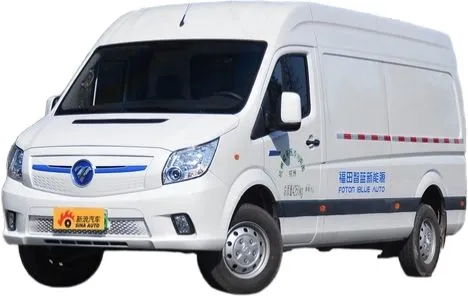
600 mm longer, 80 mm wider and 210 mm taller, with 10.4 cubic metres of published cargo volume. The CS2 publishes a 5,380 mm box length but no volume figure.
Cannot be determined from the published data. The CS2 gives 2,020 kg kerb on 3,400 kg gross, so about 1.38 t. The EV is rated 4.2 t but does not publish a kerb weight — ask, because the battery is heavy.
The TOANO EV lists ABS + EBD, ESC and EPB with auto-hold. The View CS2 sheet does not publish any brake control or stability systems.
260 km on the CHTC cycle from an 86.55 kWh pack, with 0.8 h DC or 12.5 h AC charging from 20 to 100%.
It is listed as right-hand drive for Mauritius. Confirm LHD availability before ordering if your market drives on the right.
Medium diesel box van
$19,680 · 163 hp · Foton 4F20TC10 2.0 L · 6-speed manual · GVW 3.4 t · RHD
View full specificationLarge electric cargo van
Foton TOANO EV Electric Cargo Van
$34,000 · 130 kW peak · 86.55 kWh CATL · 260 km range · 10.4 m³ · ESC
View full specification

Tel:+8615960378211
Email:[email protected]
Address: Unit 8,room 704,NO.492,XingLinWan Road,Jimei District,XiaMen Fujian China
Address: Unit 8,room 704,NO.492,XingLinWan Road,Jimei District,XiaMen Fujian China
Email:[email protected]
© Authorized Dealer of FOTON AUMAN 2026 All Rights Reserved, Auman truck is a commercial vehicle brand under the Foton Daimler
Privacy policy


