Writer:Alan Chen(Foton Auman dealer)
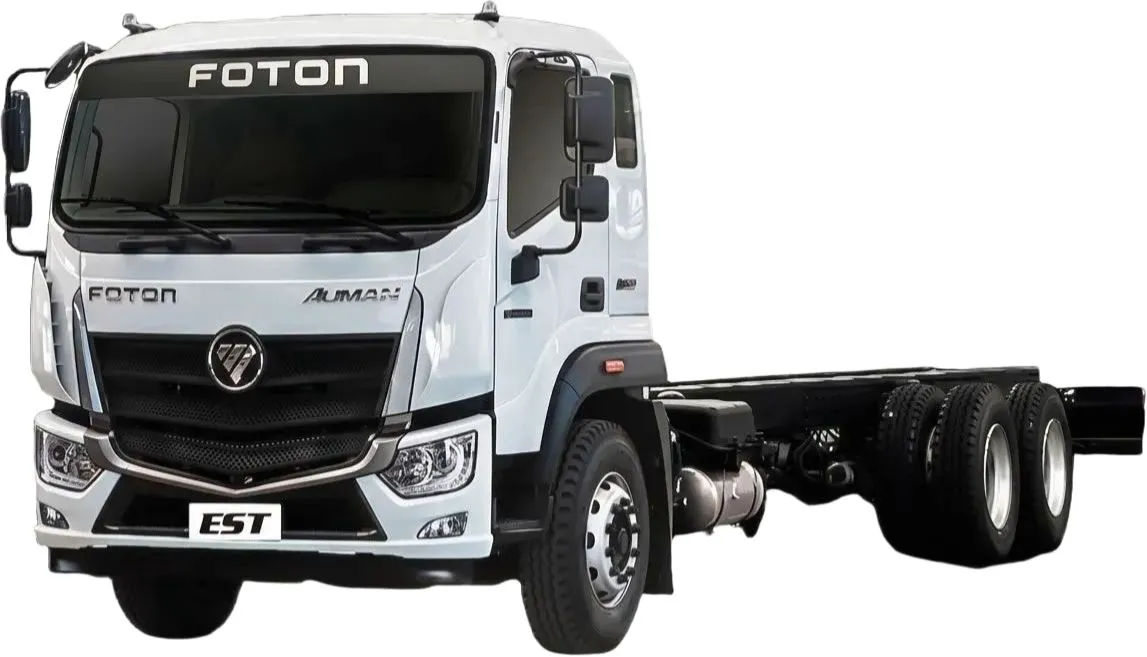
Most specification sheets say what a truck is. This one goes further and says where it expects to work: the operating-condition field reads Mining operation heavy-duty type, and the classification row beneath it says N3. Everything below takes that line seriously and asks what each published row actually does through one loaded cycle on a pit road.
The configurations compared here


The engine is where every brochure starts and it is almost never what decides the cycle. What decides the cycle is how much of the truck's permitted mass is left over once the truck itself is weighed, and this sheet is unusually candid about it: maximum design gross mass 25,000 kg, chassis kerb weight 10,460 kg. The difference is 14,540 kg, and four separate things come out of it.
| Comes out of the 14,540 kg | What the sheet says about it |
|---|---|
| The tipping body and hoist | Nothing. No body weight is published on this sheet, on any of the three variant dimensions. |
| Fuel at full tank | Tank capacity is published as 350L aluminum alloy; the sheet does not convert it to mass. |
| Two occupants | Occupants is published as 2. |
| Whatever is in the box | Everything above has to be paid for first. The remainder is the payload, and it is not published. |
So the one number a mining operation actually runs its cost model on — tonnes per trip — is the one number this sheet does not carry. It can be derived once the body builder quotes, and it cannot be derived before. Ask for it first.
Two internal box lengths are published, 5400/5600×2300×1500 mm. Taken struck, to the top rail with no heap, those are 19.32 m³ and 18.63 m³. Now put a density against them and see what happens to the scale. The arithmetic is multiplication and nothing else; no assumption about your dig is baked into it.
| Loose bulk density of the material | Full 19.32 m³ box weighs | Full 18.63 m³ box weighs | Against the remaining 14,540 kg |
|---|---|---|---|
| 0.9 t/m³ | 17.4 t | 16.8 t | Fits inside a 25,000 kg truck: no — well over it |
| 1.2 t/m³ | 23.2 t | 22.4 t | Fits inside a 25,000 kg truck: no — well over it |
| 1.5 t/m³ | 29.0 t | 27.9 t | Fits inside a 25,000 kg truck: no — well over it |
| 1.8 t/m³ | 34.8 t | 33.5 t | Fits inside a 25,000 kg truck: no — well over it |
| 2.2 t/m³ | 42.5 t | 41.0 t | Fits inside a 25,000 kg truck: no — well over it |
| 2.6 t/m³ | 50.2 t | 48.4 t | Fits inside a 25,000 kg truck: no — well over it |
Read across that table and the practical picture changes shape. Once material density climbs past roughly half a tonne to the cubic metre, the box is no longer the constraint — the axle ratings are. A truck digging iron ore, copper ore, wet gravel or blasted hard rock will reach 25,000 kg long before the loader operator has filled the corners, and the difference between a 5,600 mm box and a shorter one is then dead weight carried up every ramp, every shift, forever.


| What the cycle demands | The row that answers it | And the limit written next to it |
|---|---|---|
| Pulling away loaded on a loose ramp | Peak torque 1650/1100-1500 N·m across that whole band, from a 10338 ml inline six with no electronic injection to protect | Mechanical pump fuel delivery. Simple, field-serviceable, and a choice that also sets emission at Euro II. |
| Climbing out loaded | Drive axle ratio 5.26 behind a 16-tonne rear bogie with a 9-tonne front axle, cast housings | Maximum gradeability published at 32 (5.26)/37 (5.92)/29 (4.76) per cent depending on ratio — 32 % at the 5.26 this truck carries. |
| Holding it back on the way down | Exhaust brake listed as the auxiliary brake | It is the only retarding device on the sheet. No engine brake row, no hydraulic retarder row. Service brakes are dual-circuit air on drums front and rear. |
| Surviving the ramp surface | Rear suspension described as Disconnected balance suspension, 11/14 leaf springs, front as Longitudinal leaf spring with stabilizer bar and shock absorbers | Frame published at 225/320×90×(8+7) mm, outer width 915 mm front / 850 mm rear and axle housings cast. This is the part of the sheet that reads like it was written by someone who has seen a washboard haul road. |
| Breathing dust for a full shift | Air filter type reads Desert, muffler Longitudinal square | Fuel tank 350L aluminum alloy for range between refuels. Neither a filter service interval nor a consumption figure is published. |
| Keeping it running at the pit | Cab on Semi-floating spring suspension with manual tilt; fuel system a mechanical pump | Maximum speed published at 67 (5.26)/60 (5.92)/74 (4.76) km/h by ratio — 67 km/h at 5.26 — and the row for a speed limit value reads None. |
The strong rows are the ones nobody quotes in an advert: the rear suspension being described as disconnected balance, 25 leaves counted across the two axles, cast axle housings, and a frame with its section and both outer widths written out. Those four lines describe a chassis built to articulate over ground that is not flat, which is what a haul road is.
This is the list worth pricing before signing, because every item on it is absent rather than optional:
Governing. Speed limit value reads None and overspeed alarm value reads None. Most mine safety regimes want a governed maximum, fitted and calibrated locally.
Reversing awareness. Entertainment reads MP3 + radio + USB + no radar, and the trim line specifies manual rearview mirrors. Nothing here detects anything behind the truck, which matters more at a loading face than on a road.
Access. Working platform reads None and side skirt reads None. If crews sheet a load, check it or climb the body, a platform has to be fabricated.
Visibility and trim. No wheel cover, no AC power converter, and the rearview mirrors are manual on a trim that otherwise includes electric windows, central locking, five locks unified and an airbag seat as standard.
Fire and safety equipment. Nothing on this sheet rows it in. Whatever the site rulebook requires arrives as a local line item.
None of this is a criticism of the truck. It is what a sheet written wholesale for export looks like: the chassis is specified to a high standard for rough ground, and the site-specific fittings are deliberately left to the destination. The cost of discovering that after arrival is what makes it worth reading now.
Two situations take it off the shortlist, and the sheet itself supplies both reasons. If the haul leg is long and mostly sealed — pit gate to port, or over a hundred kilometres of tar — the 5.26 that makes it good on a ramp costs road speed it will not get back, and the 4.76 alternative in the same catalogue is the better shape. If the work answers to an emissions certificate rather than to a scale house, the Euro II row ends the conversation and the Euro V entry takes it. Mining duty does not automatically mean this truck; it means this set of rows, and those two sit on different sheets.
Every figure shown is taken from the respective published parameter sheet.


Tel:+8615960378211
Email:[email protected]
Address: Unit 8,room 704,NO.492,XingLinWan Road,Jimei District,XiaMen Fujian China
Address: Unit 8,room 704,NO.492,XingLinWan Road,Jimei District,XiaMen Fujian China
Email:[email protected]
© Authorized Dealer of FOTON AUMAN 2026 All Rights Reserved, Auman truck is a commercial vehicle brand under the Foton Daimler
Privacy policy